
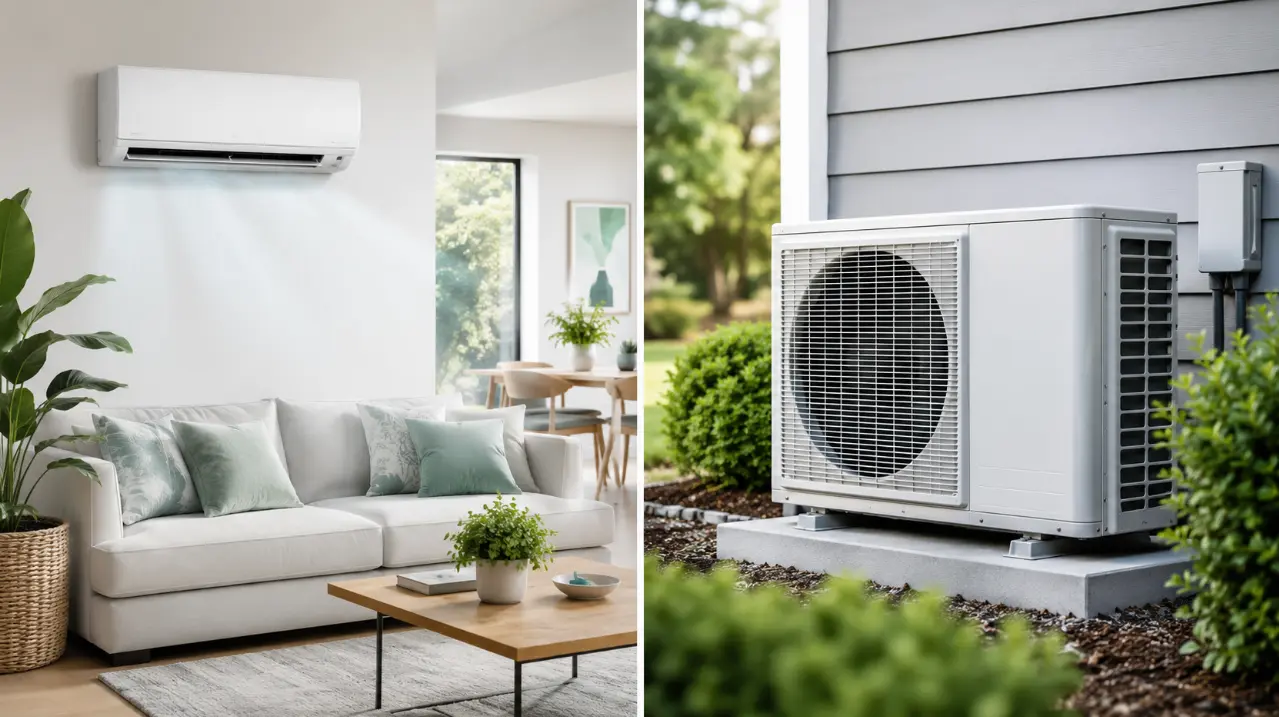
Uneven rooms, new home offices, and glassy additions challenge even well-tuned central air. In hot, dry summers with cool nights and long shoulder seasons, a ductless mini-split heat pump can solve comfort problems without reshaping your whole duct system. The key is knowing when targeted zoning, inverter-driven capacity, and no-duct losses actually outperform extending supply runs or upsizing an existing condenser. This guide walks through how to decide, from room-by-room load patterns and indoor unit placement to single-zone versus multi-zone trade-offs and the installation details owners often overlook, such as condensate routing, line-set distances, and electrical capacity.
Pinpoint the Rooms That Warrant a Ductless Zone
Start with real usage. A bonus room over the garage that bakes after 3 p.m., a sunroom with west-facing glass, or a closed-door home office loaded with a desktop tower and dual monitors all create heat gains your central system may not address evenly. Spaces used at different times than the rest of the home are strong zoning candidates. Many owners start with local resources; guides like the HVAC Company in Folsom page can help you compare ductless options with the realities of your floor plan and schedule.
How Ductless Mini-Splits Move Heat Differently
Mini-splits rely on inverter-driven compressors and variable-speed fans. Instead of cycling fully on and off, they modulate to match the room’s load, frequently idling along at low power while holding a stable setpoint. That steady operation reduces temperature swings and can be quieter than a central system’s on-off blasts, especially in small rooms. Because there are no long supply runs, there are no duct leaks or attic-conducted losses between the air handler and the occupied space. In many homes, that direct delivery is the hidden reason a modestly sized ductless zone feels stronger than a bigger central register in the same room.
Modern ductless heat pumps also reverse in winter. A mini-split with efficient SEER2 and HSPF2 ratings can heat a bedroom during cool mornings without firing a whole-house furnace. In shoulder seasons, that targeted heat can matter more than sheer summer tonnage. And because many wall cassettes offer dry mode or low fan speeds, they can fine-tune comfort when outdoor air is warm but not oppressive. In dry climates, humidity is often less of a challenge than solar gain and internal loads, which is precisely where mini-split modulation shines.
Room-by-Room Sizing and Indoor Unit Placement
Resist the urge to oversize. A proper Manual J load calculation for the individual room should drive BTU-per-hour selection. Too large a wall cassette short-cycles, leaving hot or cold spots and unnecessary noise; too small, and it runs at max output without quite catching up on late-afternoon peaks. Placement matters just as much: mount high enough to throw well over the occupied zone, avoid blasting directly at a bed or desk, and keep it clear of bookcases or soffits that trap airflow. A home office over the garage might need a 6,000 to 9,000 BTU unit, while a big, open loft with a vaulted ceiling might be better served by a ceiling cassette for wider distribution. Consider control preferences, too: remotes need line of sight, while wired controllers put setpoints where you actually sit.
Single-Zone or Multi-Zone? What Matches Your Use Pattern
One outdoor unit can serve either a single indoor head or several via a multi-port condenser or branch box. Single-zone systems often win on efficiency and simplicity when only one space truly needs help most days. They typically have great turndown at low loads, lower sound levels, and shorter, more direct line-set paths. Multi-zone systems consolidate outdoor equipment and clean up the exterior look, but they add complexity. When only one small head is calling, some multi-zone condensers are less efficient at that light load than a matched single-zone unit. Branch boxes, extra flare connections, and long line sets add more points where leaks can occur, capacity can be reduced, and defrost cycles can affect multiple zones at once.
Think about how you live. If you mainly condition a home office from 9 to 5 and an in-law suite on weekends, two single-zone systems may run more efficiently and offer better turndown than one multi-zone. If all three upstairs bedrooms need cooling every night, a compact multi-zone can make sense, especially if outdoor clearances are tight. Weigh aesthetics too: a single wall-mounted cassette is easy to service, while a recessed ceiling cassette hides better but may complicate future access and condensate routing.
Installation Realities: Power, Condensate, and Line Sets
Great design fails without sound mechanics. Mini-splits need a dedicated electrical circuit, an outdoor disconnect, and service clearances to breathe. Place the outdoor condenser where snow and leaf litter are minimal and where radiant heat from nearby walls won’t raise coil temperatures. Indoors, plan a gravity-fed condensate drain with a proper trap; if elevation forces a condensate pump, understand it adds maintenance and noise. Keep line sets within manufacturer-specified lengths and elevation changes, and protect them in UV-stable covers. Seal wall penetrations and pitch them to the exterior to guard against water intrusion. Finally, make sure a washable filter is easy to reach; if you need a step ladder over a stairwell to clean it, you will not do it often enough.
If a room is chronically uncomfortable because of duct issues rather than heat gain, address basics before adding equipment. Balancing registers, sealing a leaky supply run in the attic, or adding a return grille can fix a problem corner for less money. When the load is truly room-specific, a correctly sized mini-split with smart placement is often the more elegant solution.
Choosing a ductless path works best when you define the room’s real load, schedule, and constraints. Confirm the BTU sizing with a Manual J, sketch the line-set route and condensate path, and decide early between single-zone simplicity and multi-zone consolidation. Ask for equipment data that lists SEER2, HSPF2, minimum and maximum capacities, and noise ratings, and request a layout drawing that shows indoor unit heights and throws. With those pieces in place, a mini-split can solve the exact comfort gap you feel every day without rewriting your entire central system.

















Leave a Reply