
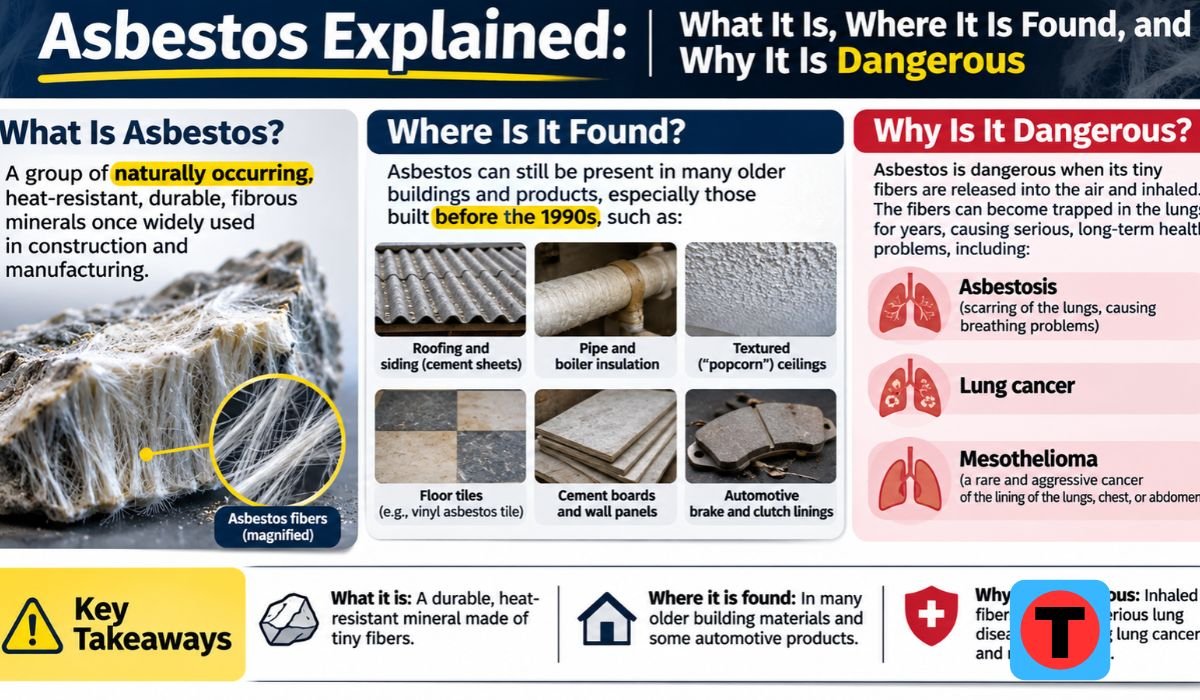
Imagine renovating an old home, replacing ceiling tiles, or removing outdated insulation without realizing that the materials could contain a dangerous substance. That substance is Asbestos, a naturally occurring mineral group that was once valued for its strength, durability, and resistance to heat.
For generations, manufacturers considered Asbestos an exceptionally useful material. However, scientific research eventually revealed that breathing in its microscopic fibers could cause serious and sometimes fatal diseases.
In 2026, Asbestos remains an important public health concern because many older buildings still contain it. Understanding its properties, uses, health risks, and appropriate safety measures can help individuals make informed decisions without unnecessary fear.
Quick Bio Information About Asbestos
| Category | Information |
|---|---|
| Common Name | Asbestos |
| Alternative Name | Asbestus |
| Mineral Category | Silicate Minerals |
| Origin | Naturally Occurring |
| Recognized Types | Six Main Types |
| Mineral Groups | Serpentine and Amphibole |
| Most Widely Used Type | Chrysotile |
| Common Colors | White, Brown, Blue, Gray, and Green |
| Physical Structure | Thin, Fibrous Crystals |
| Key Properties | Heat Resistance and Durability |
| Historical Uses | Pottery, Textiles, and Insulation |
| Industrial Expansion | 19th Century |
| Common Locations | Older Buildings and Industrial Equipment |
| Primary Exposure Route | Inhalation of Airborne Fibers |
| Health Classification | Human Carcinogen |
| Associated Diseases | Mesothelioma, Asbestosis, and Lung Cancer |
| Disease Latency | Often Several Decades |
| Identification Method | Professional Laboratory Testing |
| Global Status | Banned or Restricted in Many Countries |
| Main Prevention Method | Avoiding Exposure |
What Is Asbestos?
Asbestos is the collective name for a group of naturally occurring silicate minerals that form long, thin fibers. Unlike ordinary minerals that appear as solid crystals, Asbestos can separate into extremely small fibers that may become airborne. Its appearance varies according to the mineral type and the material in which it is contained. It can appear white, brown, blue, gray, or green. However, identifying Asbestos through appearance alone is unreliable, particularly when it has been mixed with cement, insulation, or other construction materials. Laboratory testing is generally necessary to confirm its presence.
History and Origins of Asbestos
The history of Asbestos stretches back thousands of years. Archaeological evidence suggests that ancient communities used it to strengthen pottery and create fire-resistant materials. Commercial mining expanded during the nineteenth century, particularly in Canada and other mineral-producing regions. By the twentieth century, Asbestos had become common in buildings, factories, ships, and household products. Early warnings about its health effects appeared in the late nineteenth century, while medical investigations during the following decades established connections between workplace exposure and serious lung disease. These discoveries eventually encouraged governments to introduce protective regulations.
The Six Types of Asbestos
Asbestos is divided into two mineral families: Serpentine and Amphibole. Chrysotile, commonly called White Asbestos, belongs to the Serpentine family and has relatively curved fibers. The Amphibole family includes Amosite, Crocidolite, Tremolite, Anthophyllite, and Actinolite. Amosite is often called Brown Asbestos, while Crocidolite is known as Blue Asbestos. Although their chemical compositions and fiber structures differ, none should be considered harmless. The World Health Organization recognizes all six main forms as carcinogenic to humans, including Chrysotile, which has historically been the most widely used variety.
who.int+1
Why Was Asbestos Widely Used?
Manufacturers once appreciated Asbestos because it offered several valuable industrial properties. Its fibers were strong, relatively flexible, and highly resistant to heat. It also provided thermal and electrical insulation, making it useful in factories, power plants, and buildings. Manufacturers could combine it with cement and other materials to produce durable products at competitive prices. Its ability to withstand demanding environments helped it become an important component in fire-resistant clothing, roofing, machinery, and transportation equipment. Unfortunately, the same durable fibers that made Asbestos commercially attractive also contributed to its serious health risks.
Where Is Asbestos Commonly Found?
Older residential and commercial buildings remain important potential sources of Asbestos. It may be present in roofing sheets, vinyl floor tiles, ceiling panels, pipe insulation, cement products, textured wall coatings, and fire-resistant boards. Historical industrial applications also included brake components, clutches, boilers, electrical equipment, and ship insulation. Some deposits occur naturally in rocks and soil. Importantly, a building’s age alone cannot confirm whether Asbestos is present. Construction practices varied between countries, and materials containing Asbestos may remain hidden behind walls or underneath newer flooring.
HSE
How Asbestos Exposure Occurs
Asbestos Exposure generally occurs when microscopic fibers enter the air and are inhaled. Activities such as drilling, cutting, sanding, demolition, and renovation can disturb materials containing these fibers. Deteriorating insulation and damaged building products may also release them. Exposure is not limited to industrial workplaces. Workers may unintentionally carry contaminated dust home on their clothing, creating potential risks for family members. Intact materials that remain undisturbed generally present a lower risk than damaged or crumbling products. Professional assessment can help determine how suspected materials should be managed.
epa.gov
Why Is Asbestos Dangerous?
The greatest danger associated with Asbestos comes from its microscopic fibers. After inhalation, some fibers may remain within the lungs or surrounding tissues for extended periods. Their presence can contribute to inflammation, scarring, and cellular damage that may eventually lead to cancer. The likelihood of illness generally increases with greater and longer exposure, although no exposure level has been established as completely safe. According to the World Health Organization’s August 2026 update, occupational Asbestos Exposure is estimated to cause more than 200,000 deaths worldwide annually, based on 2016 burden estimates.
who.int
Diseases Caused by Asbestos Exposure
Asbestos Exposure is associated with several serious health conditions. Asbestosis is a chronic disease involving lung scarring that can gradually make breathing more difficult. Mesothelioma is a cancer that commonly affects the lining surrounding the lungs or abdomen. Asbestos also increases the risk of Lung Cancer, particularly among individuals who smoke. Other associated conditions include Pleural Plaques, Pleural Thickening, and Pleural Effusion. Scientific evidence also establishes a connection with Laryngeal and Ovarian Cancer. These diseases may develop many years after the original exposure, making prevention especially important.
NCI+1
Symptoms of Asbestos-Related Diseases
The symptoms of Asbestos-related illnesses vary according to the condition and its severity. Common warning signs may include persistent coughing, shortness of breath, chest discomfort, fatigue, and unexplained weight loss. Some individuals experience no noticeable symptoms for decades after exposure. According to the National Cancer Institute, symptoms may take between 10 and 40 years or longer to appear. These symptoms can also result from unrelated medical conditions, so they cannot confirm Asbestos-related disease. Individuals concerned about previous exposure should discuss their occupational and medical history with a healthcare professional.
Who Is Most at Risk?
Construction Workers, Electricians, Plumbers, Miners, Shipyard Workers, Mechanics, and Demolition Workers may face increased risks when their work involves materials containing Asbestos. Building maintenance personnel can also encounter hidden Asbestos during repairs. Homeowners undertaking renovation projects without professional inspections may unknowingly disturb affected materials. People who live near certain mining or industrial operations may face environmental exposure. Although workplace safety standards have improved in many countries, older buildings and equipment continue to create potential hazards in 2026.
How to Identify Asbestos in Your Home
Identifying Asbestos requires more than examining the color or texture of a building material. Older insulation, cement roofing, ceiling tiles, and flooring may warrant professional investigation, especially before renovation. A qualified Asbestos Inspector can examine the property, review its construction history, assess material conditions, and arrange appropriate laboratory testing. Homeowners should avoid collecting their own samples because disturbing suspected materials may release fibers. An inspection can also help determine whether materials require ongoing management, professional treatment, or removal.
What to Do If You Find Asbestos
Discovering suspected Asbestos does not automatically mean that everyone inside a building is in immediate danger. However, it is important to respond carefully. Stop activities that might disturb the material and keep other people away from the affected area. Avoid drilling, breaking, sanding, sweeping, or using an ordinary vacuum cleaner on suspected debris. Contact a qualified Asbestos Professional for advice. Depending on the material’s condition, specialists may recommend monitoring it, sealing it, or arranging professional removal. Taking appropriate precautions is more useful than attempting an immediate DIY cleanup.
epa.gov
How Professional Asbestos Removal Works
Asbestos Removal, also known as Asbestos Abatement, involves professionally managing or removing hazardous materials while limiting fiber release. Specialists assess the affected area and determine the appropriate treatment based on the material’s condition and local regulations. Some intact materials may be safely managed through monitoring or encapsulation, rather than removal. When removal is necessary, qualified contractors use specialized containment, protective equipment, and approved waste disposal procedures. Post-removal assessments may also be required. Ordinary home renovation methods are not suitable substitutes for professional Asbestos management.
Asbestos Regulations and Bans in 2026
Many governments have introduced laws restricting Asbestos because of its serious health consequences. The United Kingdom prohibited its use in construction and refurbishment in 1999, while Australia’s comprehensive ban took effect in December 2003. Canada introduced extensive prohibition regulations in December 2018. In the United States, the Environmental Protection Agency finalized a rule in March 2024 to prohibit ongoing Chrysotile Asbestos uses through different phase-out deadlines. However, existing materials remain a concern. Regulations differ internationally, and Asbestos continues to be used in some regions.
HSE+3
Modern Alternatives and Asbestos Prevention
Modern construction and manufacturing offer various alternatives, including Mineral Wool, Fiberglass, Cellulose Insulation, Calcium Silicate, and Asbestos-free Fiber Cement. The appropriate replacement depends on the required insulation, strength, and fire resistance. These materials may still require their own safety precautions. Effective Asbestos Prevention also involves inspecting older properties before renovation, maintaining accurate building records, educating workers, and following occupational safety requirements. In 2026, managing aging infrastructure is particularly important because deteriorating materials and increasing renovation activity can create fresh exposure risks long after Asbestos was originally installed.
Final Thoughts
Asbestos represents an important lesson in the relationship between industrial innovation and public health. Although its durability and fire-resistant properties once made it valuable, the serious illnesses associated with exposure demonstrate why material safety must remain a priority.
The continuing presence of Asbestos in older buildings makes awareness essential. Understanding where it may be found, avoiding unnecessary disturbance, and seeking professional assistance can significantly reduce exposure risks.
Rather than creating unnecessary fear, accurate information empowers homeowners, workers, and communities to make responsible decisions and protect future generations.
FAQs About Asbestos
What Is Asbestos?
Asbestos is a group of naturally occurring fibrous minerals historically used in construction, insulation, and manufacturing because of their strength and resistance to heat. All recognized types can cause serious illnesses when their fibers are inhaled.
Why Is Asbestos Dangerous?
Asbestos is dangerous because its microscopic fibers can remain within the body after inhalation. Over time, these fibers may contribute to tissue damage, chronic respiratory diseases, and cancers.
Is Asbestos Dangerous If Left Untouched?
Intact Asbestos-containing materials generally present a lower exposure risk when they remain undisturbed. However, their condition should be professionally assessed, particularly before maintenance, repairs, or renovation.
Can You Identify Asbestos by Looking at It?
No. Many Asbestos-containing products look similar to ordinary construction materials. Reliable identification generally requires professional assessment and laboratory analysis of safely collected samples.
Can a Single Asbestos Exposure Cause Illness?
A brief exposure does not necessarily result in illness. However, there is no established completely safe exposure threshold. Risk depends on factors such as the amount of airborne fibers and duration of exposure.
Is Asbestos Still Used in 2026?
Yes. Although numerous countries have banned or restricted Asbestos, some continue to permit its use. Previously installed Asbestos-containing products also remain in buildings and industrial equipment worldwide.
How Long Does Asbestos Take to Affect Your Health?
Asbestos-related diseases often develop several decades after exposure. Symptoms may appear 10 to 40 years later or even longer, depending on the disease and individual circumstances.
Can Asbestos Be Safely Removed?
Yes, qualified Asbestos Abatement Professionals can remove affected materials using appropriate safety procedures, containment measures, and regulated disposal methods. Homeowners should avoid attempting Asbestos Removal themselves.
Learn more and explore exciting content on: Printer Explained: Types, Uses, Features, and How It Works












Leave a Reply