
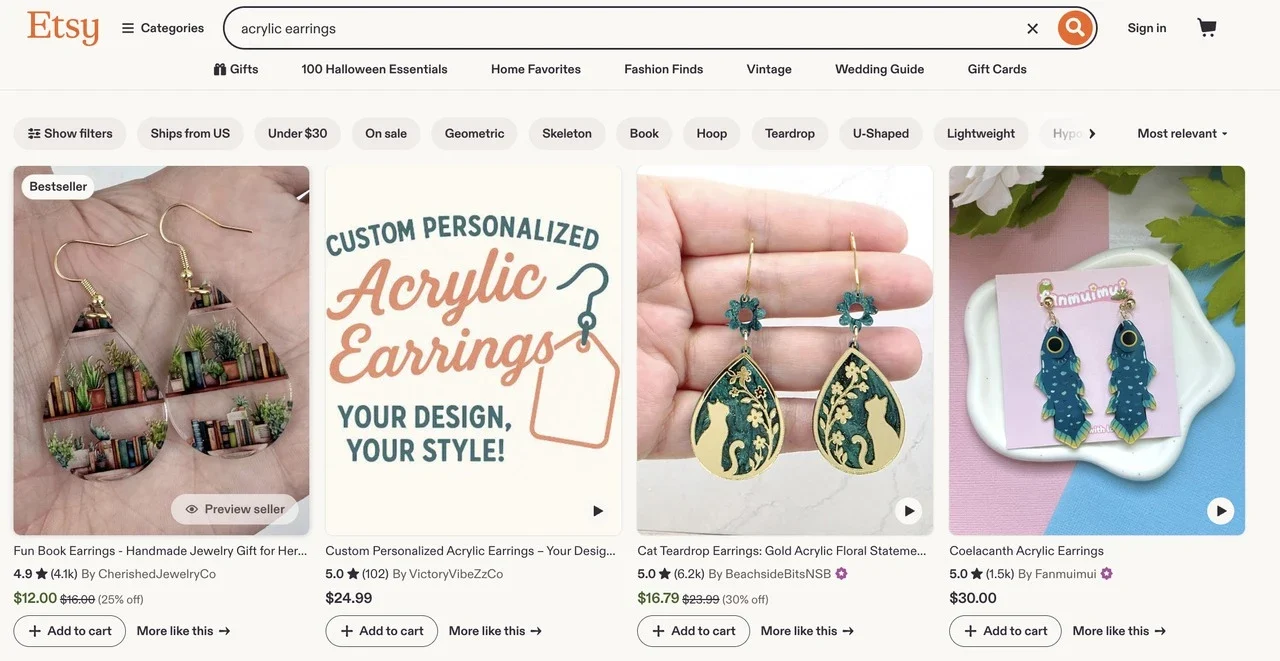
Starting an Etsy shop can be an appealing way to turn a creative interest into a small business. However, choosing what to sell is often more difficult than setting up the storefront. Some products require expensive equipment, others involve hours of custom work, and certain categories have more competition than a new seller may initially expect.
The most sensible approach is to find a product category that matches your skills, has a clearly defined audience, and can be produced at a cost that leaves room for profit. Exploring profitable etsy shop ideas is therefore less about following every popular trend and more about finding a business model that is practical to maintain.
Personalised Products for Specific Occasions
Personalised merchandise is an interesting starting point because customers often look for items connected to particular people, celebrations, or memories. Possible products include custom name signs, engraved accessories, personalised notebooks, pet portraits, wedding keepsakes, and family gift sets. Rather than offering every possible type of personalised item, a beginner can concentrate on one audience.
For example, a shop might specialise in gifts for new homeowners or personalised accessories for pet owners. A narrower focus makes it easier to develop a consistent product range and understand what customers expect. The main challenge is managing custom orders. Sellers need a clear process for collecting names, dates, photographs, and design preferences. They should also account for revisions and production time when calculating prices.
Digital Downloads with a Defined Purpose
Digital products are worth considering because they do not require physical inventory or individual shipping. Once an original file has been created, it can generally be delivered electronically to customers. Potential products include printable planners, budget worksheets, wedding stationery templates, educational activity sheets, business forms, and illustrated wall art.
The key is creating something that solves a specific problem. A general planner may compete with countless similar products, while a carefully designed planner for freelance photographers or small event organisers serves a more identifiable audience. Digital sellers should provide clear file descriptions, page dimensions, supported formats, and printing instructions. Buyers need to understand exactly what they will receive before purchasing. Originality also matters: selling other people’s artwork or simply repackaging existing files is not a sustainable foundation for a creative shop.
Hobby Kits and Creative Supplies
People interested in crafts often need more than finished products. They also look for materials and beginner-friendly kits that help them create something themselves. Possible shop categories include embroidery starter kits, bead jewellery supplies, miniature painting accessories, scrapbooking materials, and beginner needlecraft packages.
A well-organised kit can be more useful than a collection of unrelated supplies. For example, an embroidery kit might include fabric, thread, a suitable needle, a printed pattern, and straightforward instructions. The seller’s responsibility is to describe the contents accurately and make the difficulty level clear. Missing components, unclear instructions, and unsuitable materials can create avoidable customer complaints.
Small Home Decor and Custom Accessories
Home decor offers room for creativity because products can be designed around different interiors, colour preferences, and personal interests. Useful options include decorative trays, custom signs, wall organisers, personalised coasters, miniature planters, and desk accessories. Small products can also be easier to package and ship than large decorative pieces.
For those exploring etsy shop ideas for beginners, customisation offers another way to distinguish a product. For instance, compatible hard-surface accessories can be decorated with original graphics using suitable printing equipment. Brands such as eufyMake offer UV printing solutions that can be relevant to this type of creative production. Before choosing this category, consider material costs, finishing time, packaging protection, and the possibility of damage during delivery.
Handmade and Personalised Textile Products
Textile products can appeal to buyers who appreciate craftsmanship and distinctive details. Potential items include embroidered pouches, fabric bookmarks, reusable shopping bags, decorative cushion covers, and personalized textile gifts. A focused product range can help a new seller develop a recognisable style. For example, a shop specialising in embroidered accessories for book lovers has a clearer identity than one selling unrelated clothing, home decor, and jewellery. The challenge is balancing handmade quality with production capacity. Calculate how long each item takes to make, including preparation, finishing, packaging, and communication with customers. Pricing only for the raw materials can make a shop appear successful while leaving the seller with very little actual earnings.
How to Tell Whether an Idea Has Business Potential
An attractive product is not necessarily a profitable one. Before investing in materials or equipment, evaluate the idea using four practical questions:
Is there a recognizable customer? Identify who would purchase the item and why they might choose it over alternatives.
Can the product be made consistently? Consider whether you can reproduce the same quality without excessive time or complicated processes.
Do the numbers work? Include materials, labour, packaging, marketplace charges, shipping costs, and a reasonable allowance for mistakes or replacements.
Can the listing communicate its value? Clear photographs, accurate dimensions, material details, and useful descriptions help customers understand what they are buying.
Researching competing listings can also reveal common price ranges, design approaches, and customer questions. However, copying another seller’s photographs, artwork, descriptions, or distinctive designs is not a substitute for developing an original product.
Etsy Shop Ideas for Beginners: A Sensible Starting Plan
Rather than launching with dozens of unrelated products, begin with a small collection of items that appeal to the same audience. Prepare a few variations, photograph actual finished products, and calculate the complete cost of producing each one. Make sure the products and production methods comply with Etsy’s current marketplace requirements. Original designs, permitted production arrangements, accurate product descriptions, and appropriate disclosure of production partners are important considerations. After publishing the first listings, monitor customer questions, visits, orders, and feedback. These observations can help identify which products deserve further development and which ones need changes.
Final Thoughts
Building an Etsy business starts with more than finding a popular product category. Personalised gifts, digital downloads, craft kits, home accessories, and handmade textiles all offer possible directions, but their potential depends on customer demand, production costs, and the seller’s ability to maintain quality. A focused collection, realistic pricing, and original designs provide a more useful starting point than trying to sell everything at once.
Frequently Asked Questions
1. Can I start an Etsy shop without making physical products?
Yes. Original digital downloads, such as planners, templates, worksheets, and artwork, can be offered without maintaining physical inventory. The digital content must meet the marketplace’s applicable originality and listing requirements.
2. How many products should a beginner list initially?
There is no fixed number that guarantees success. Starting with a manageable collection of related products makes it easier to maintain quality, organise listings, and understand customer responses before expanding.
3. Are personalised products difficult to manage?
They can require additional communication because buyers may submit names, images, dates, or other details. Clear customisation instructions, proofing procedures, and realistic processing times can make order management easier.
4. How can I calculate the profit on an Etsy product?
Subtract all relevant expenses from the selling price. Include materials, labour, packaging, marketplace and payment processing charges, shipping expenses paid by the seller, and allowances for replacements or waste. The remaining amount is closer to the actual profit than the difference between selling price and material cost alone.
5. Can a seller use a third-party company to produce Etsy products?
Certain production arrangements are permitted when they meet Etsy’s applicable requirements. Sellers should ensure the underlying designs or qualifying customisation are their own, disclose production partners where required, and describe how and where products are made and shipped accurately.















Leave a Reply