
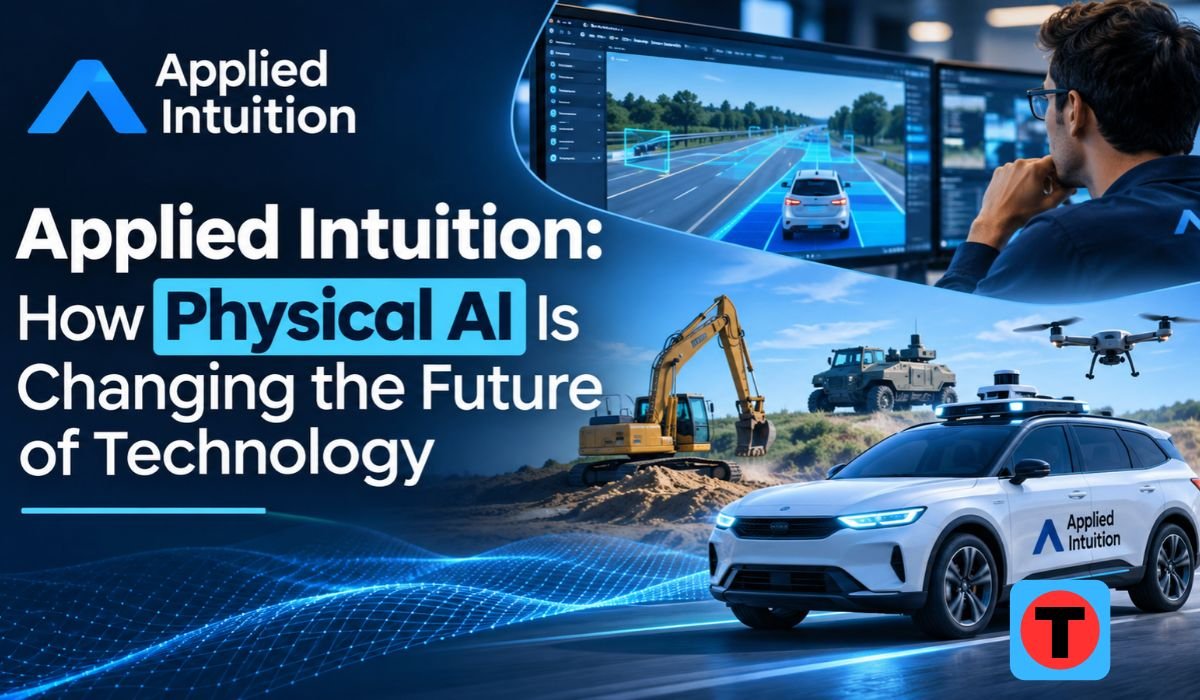
Artificial Intelligence is no longer limited to chatbots, search engines, and digital applications. It is becoming an important part of machines that move, work, and make decisions in the real world. Applied Intuition is one of the technology companies helping make this transformation possible through advanced software, simulation tools, and intelligent systems.
Based in Silicon Valley, Applied Intuition focuses on making vehicles and other physical machines smarter, safer, and more reliable. Its technology supports industries ranging from automotive manufacturing and commercial transportation to construction, agriculture, and defense.
As Physical AI continues to develop in 2026, understanding Applied Intuition offers a useful look at how Artificial Intelligence is moving beyond computer screens and becoming part of everyday industrial technology.
What Is Applied Intuition?
Applied Intuition is an American technology company specializing in vehicle software, simulation technology, and autonomous systems. Founded in 2017, the company helps manufacturers and engineering teams develop, test, and improve intelligent machines.
Unlike companies that primarily create consumer AI applications, Applied Intuition focuses on software used in physical environments. Its tools help engineers understand how vehicles and machines behave under different conditions.
For example, an autonomous vehicle must recognize obstacles, respond to traffic, and make safe decisions. Applied Intuition’s technology helps developers simulate and evaluate these situations before testing them in the real world.
The company also works on software-defined vehicles, where digital systems manage and improve important vehicle functions. This combination of simulation, Artificial Intelligence, and engineering makes Applied Intuition an important participant in the growing Physical AI industry.
Quick Bio Information
| Company Information | Details |
|---|---|
| Company Name | Applied Intuition |
| Founded | 2017 |
| Founders | Qasar Younis and Peter Ludwig |
| Headquarters | Sunnyvale, California, United States |
| Industry | Automotive Software and Physical AI |
| Company Type | Privately Held Technology Company |
| Primary Focus | Intelligent Vehicles and Autonomous Systems |
| Core Technology | Simulation and Vehicle Software |
| AI Specialization | Physical AI and Autonomous Technology |
| Major Applications | Automotive, Trucking, Construction, Agriculture, Defense |
| Early Product | Planning Simulator |
| Early Team Size | Approximately 15 Employees in 2019 |
| Reported Workforce | More Than 1,300 Employees |
| Reported Engineering Team | More Than 1,000 Engineers |
| Reported Valuation | $15 Billion |
| Reported Annual Simulation Activity | 50 Million Customer Simulations |
| International Markets Mentioned | Japan, South Korea, Germany, Sweden |
| Featured Technical Executive | Malhar Patel, Deputy CTO |
| Workplace Model | Five Days Per Week In Office |
Workforce, valuation, and simulation figures reflect the company’s reported position in the supplied firsthand account. They are not independently audited figures.
The History and Growth of Applied Intuition
Applied Intuition began in 2017 with the goal of improving how autonomous technology is developed and tested. Its early work centered on simulation software that allowed engineers to examine vehicle behavior in controlled virtual environments.
By early 2019, the company had approximately 15 employees and a small customer base. Engineers worked closely together, often taking responsibility for several different areas of the business.
One early employee, Malhar Patel, described how the company operated without complicated organizational structures. Its main priority was building useful technology for customers.
Over time, Applied Intuition expanded its engineering workforce, developed additional software capabilities, and established relationships with international customers. Its growth illustrates how specialized engineering software can become increasingly valuable as industries adopt more advanced automation.
Who Founded Applied Intuition?
Applied Intuition was founded by Qasar Younis and Peter Ludwig, two technology leaders who recognized the growing need for better software development tools in the automotive industry.
Younis previously served as Chief Operating Officer at Y Combinator and brought experience in technology entrepreneurship and business development. Ludwig contributed extensive technical expertise and became central to the company’s engineering direction.
Together, they established a company culture focused on practical problem-solving, technical excellence, and customer needs.
Their approach emphasizes building reliable products rather than pursuing technology trends without clear applications. This philosophy has influenced Applied Intuition’s hiring practices, engineering operations, and long-term development.
Understanding Physical AI and How It Works
Physical AI refers to Artificial Intelligence used in machines that interact with the real world. Unlike traditional software systems that mainly process digital information, Physical AI must account for movement, physical surroundings, and unpredictable conditions.
An autonomous vehicle provides a clear example. It receives information from cameras, radar, and other sensors, interprets its environment, and makes decisions about steering, braking, or acceleration.
These decisions must happen quickly and reliably. A mistake in a digital recommendation may be inconvenient, but an error involving a moving machine can create serious safety risks.
Physical AI therefore requires more than intelligent algorithms. It also depends on accurate sensing, dependable hardware, software integration, and extensive testing.
Applied Intuition supports this development process by providing technologies that help engineers evaluate how intelligent systems behave.
How Applied Intuition Uses AI and Simulation Technology
Simulation is one of the most important technologies associated with Applied Intuition. It allows engineers to create virtual environments that represent real-world situations.
Developers can test how autonomous systems respond to pedestrians, changing weather, unusual road layouts, and unexpected obstacles without exposing people to unnecessary danger during early testing.
Simulation also makes it possible to repeat difficult scenarios and compare different software versions under similar conditions.
The company’s firsthand account reports that customers conduct approximately 50 million simulations annually using infrastructure that handles hundreds of petabytes of data.
However, simulation alone cannot establish that a vehicle is safe. Physical testing, independent validation, and regulatory compliance remain essential.
The greatest benefit comes from combining virtual testing with real-world engineering evidence.
Applied Intuition Products and Technology Solutions
Applied Intuition has developed software capabilities covering several stages of intelligent vehicle development.
Its simulation technology helps engineers create scenarios, examine system performance, and identify potential weaknesses. Development and validation tools support the evaluation of autonomous driving software and related systems.
The company’s broader vehicle software work also addresses the growing importance of software-defined vehicles.
A software-defined vehicle relies on digital architecture to manage functions that previously depended more heavily on separate hardware components. This approach can support software updates, improved integration, and the development of new features.
Applied Intuition’s combination of simulation, data infrastructure, and vehicle software helps manufacturers manage increasingly complex engineering requirements.
Specific product capabilities and commercial availability can vary by platform and customer agreement.
Industries Using Applied Intuition Technology
Applied Intuition’s technology is relevant to several industries that depend on reliable machines and intelligent software.
In the automotive sector, simulation and validation tools help manufacturers develop advanced driver-assistance systems and autonomous driving capabilities.
Commercial trucking presents different challenges, including large vehicle dimensions, long-distance operations, and complicated logistics environments.
Construction and agricultural machinery also offer opportunities for automation. Intelligent equipment may help operators perform repetitive tasks, navigate controlled environments, and improve operational efficiency.
Defense and aerospace applications introduce additional requirements involving reliability, security, and operation under demanding conditions.
Although these industries have different needs, they share an important challenge: intelligent machines must perform consistently in environments that are not always predictable.
Applied Intuition and the Future of Autonomous Vehicles
Autonomous vehicles have the potential to change transportation, but developing them remains technically difficult.
A self-driving system must interpret its surroundings, predict the behavior of other road users, and make decisions under uncertainty. Even familiar driving situations can become complicated when weather, visibility, or human behavior changes.
Applied Intuition helps address these challenges through development and testing technologies.
Its simulation tools allow engineers to investigate difficult scenarios before conducting physical tests. This can make development more efficient and help teams identify weaknesses earlier.
Still, fully autonomous transportation requires progress across several areas, including sensor performance, software reliability, public trust, and regulatory approval.
Applied Intuition’s role is primarily to support the companies and organizations developing these systems, rather than simply operating a consumer self-driving car service.
Applied Intuition Valuation, Funding, and Business Growth
Applied Intuition has attracted substantial investment as demand for autonomous technology and intelligent vehicle software increases.
In March 2024, the company announced a $250 million Series E funding round at a $6 billion valuation. In June 2025, it announced a $600 million Series F financing and tender offer at a $15 billion valuation.
The later transaction was co-led by BlackRock-managed funds and Kleiner Perkins, with participation from other international investors.
These investments reflect confidence in the company’s technology and market opportunities. However, valuation represents an investment-based estimate of company worth, not its annual revenue or profit.
The company’s expanding product portfolio and relationships with major manufacturers also demonstrate its growing commercial reach.
Applied Intuition Leadership and Engineering Expertise
Engineering expertise plays a central role in Applied Intuition’s operations. According to a firsthand account by Deputy CTO Malhar Patel, the company has more than 1,000 engineers working across different technical areas.
Patel joined in early 2019 as a graduate engineer and later worked in infrastructure, machine learning, recruiting, customer operations, and engineering leadership.
His career illustrates the company’s emphasis on developing employees internally.
The organization also recruits domain specialists, recent graduates, and experienced technology founders.
Patel reports that approximately 70–80% of management positions are filled through internal promotions.
This approach helps preserve institutional knowledge while giving employees opportunities to develop new skills and responsibilities.
What Makes Applied Intuition’s Workplace Culture Unique?
Applied Intuition has developed a workplace culture centered on technical excellence, practical thinking, and quick decision-making.
Employees generally work in person five days per week, reflecting the company’s preference for direct collaboration.
Engineers are encouraged to contribute code shortly after joining and participate actively in solving customer problems.
The company also favors short, purposeful meetings instead of unnecessary recurring discussions.
One unusual tradition is its no-shoes office policy, which began during its early startup years and continued as the business expanded.
Although these practices may support collaboration and efficiency, they may not suit every employee.
The company’s culture emphasizes individual responsibility, continuous improvement, and maintaining high engineering standards.
Careers and Job Opportunities at Applied Intuition
Applied Intuition offers career paths related to software engineering, machine learning, simulation, autonomous systems, infrastructure, and technical leadership.
Its recruitment philosophy combines experienced specialists with graduates who demonstrate strong problem-solving abilities.
Candidates may participate in technical interviews and conversations with company leaders to evaluate their skills and working style.
Employees may also have opportunities to collaborate with international customers or work on projects involving different industries.
The company’s focus on internal promotions can create professional development opportunities for engineers interested in leadership.
However, applicants should carefully consider the company’s in-office expectations, demanding technical environment, and role-specific requirements before applying.
Applied Intuition’s Global Presence and Partnerships
Applied Intuition operates internationally because its customers include manufacturers and technology organizations across several major industrial markets.
The company has established operations and customer relationships in regions including Europe and Asia.
Its engineers sometimes work directly with customers to understand technical problems, support integration, and improve software performance.
Publicly announced relationships have included Porsche, Volkswagen Group companies, Isuzu, TRATON, Stellantis, and OpenAI.
These collaborations cover different areas of vehicle intelligence, software development, and autonomous technology.
Working closely with manufacturers helps Applied Intuition understand practical engineering requirements rather than developing products based entirely on theoretical assumptions.
Challenges Facing Applied Intuition and Physical AI
Despite significant progress, Physical AI remains a difficult field.
Intelligent machines must operate reliably in environments where unexpected events can occur. Weather changes, sensor failures, unusual obstacles, and human behavior can all affect performance.
Developing software capable of handling these situations requires extensive data, computing infrastructure, and testing.
Regulatory requirements also vary between industries and countries, making international deployment more complicated.
Applied Intuition must additionally compete with established automotive suppliers, specialized software developers, and emerging AI companies.
As its business expands, maintaining engineering quality and organizational efficiency will remain important.
The company’s long-term success will depend not only on innovation but also on whether its technology consistently delivers practical value.
The Future of Applied Intuition and Physical AI Technology
The future of Applied Intuition is closely connected to the development of increasingly intelligent machines.
As of 2026, its technology portfolio includes simulation and validation tools, Vehicle OS, self-driving systems, and specialized autonomy solutions.
Its broader Physical AI platform, Dana, reflects an ambition to support the development, deployment, and operation of intelligent machines across multiple industries.
Potential applications extend beyond passenger vehicles to robotics, mining equipment, agricultural machinery, commercial transportation, and defense systems.
The most important opportunity may be making advanced autonomy easier for manufacturers to develop and maintain.
However, widespread adoption will depend on safety, cost, regulation, and real-world performance.
Applied Intuition’s progress will therefore be measured by how effectively its technology moves from development environments into dependable practical applications.
FAQs About Applied Intuition
What Does Applied Intuition Do?
Applied Intuition develops software that helps companies build, test, validate, and operate intelligent vehicles and machines. Its main technologies include simulation tools, vehicle software platforms, and autonomous system solutions.
Who Founded Applied Intuition?
Applied Intuition was founded in 2017 by Qasar Younis and Peter Ludwig. Their combined business and engineering expertise helped establish the company’s focus on reliable software and intelligent vehicle technology.
Where Is Applied Intuition Located?
Applied Intuition is headquartered in Sunnyvale, California. The company also maintains international operations to support customers in major automotive, industrial, and technology markets.
What Is Applied Intuition’s Valuation?
Applied Intuition announced a $15 billion valuation in June 2025 following its Series F financing and tender offer. This figure represents its publicly reported investment valuation rather than annual revenue.
Does Applied Intuition Build Self-Driving Cars?
Applied Intuition primarily develops software and technology used by manufacturers and organizations creating autonomous vehicles. Its products support simulation, testing, vehicle software development, and autonomous driving capabilities.
What Is Physical AI?
Physical AI refers to Artificial Intelligence that enables machines to perceive their surroundings, make decisions, and interact with physical environments. Examples include autonomous vehicles, industrial robots, and intelligent machinery.
Is Applied Intuition a Good Company to Work For?
Applied Intuition may appeal to engineers who enjoy complex technical challenges, practical problem-solving, and collaborative work. Its demanding engineering culture and five-day in-office model are important considerations for prospective employees.
Why Is Applied Intuition Important?
Applied Intuition helps bridge the gap between Artificial Intelligence research and real-world machine applications. Its technology supports the development and validation of autonomous systems that could improve transportation, industrial productivity, and operational safety.
Final Thoughts
Applied Intuition represents an important development in the evolution of Artificial Intelligence. Rather than focusing only on digital applications, the company builds software that helps machines operate more intelligently in the physical world.
Its growth from a small engineering startup into a multibillion-dollar technology business highlights the increasing demand for simulation, autonomous systems, and advanced vehicle software.
As Physical AI develops, companies will need reliable tools to transform promising ideas into practical technologies.
Applied Intuition is helping provide that foundation. Its future will depend on continued engineering progress, strong customer relationships, and the ability to deliver intelligent systems that work safely and consistently beyond the laboratory.
Learn more and explore exciting content on: Innago: A Complete Guide to Smarter and Easier Property Management









Leave a Reply