
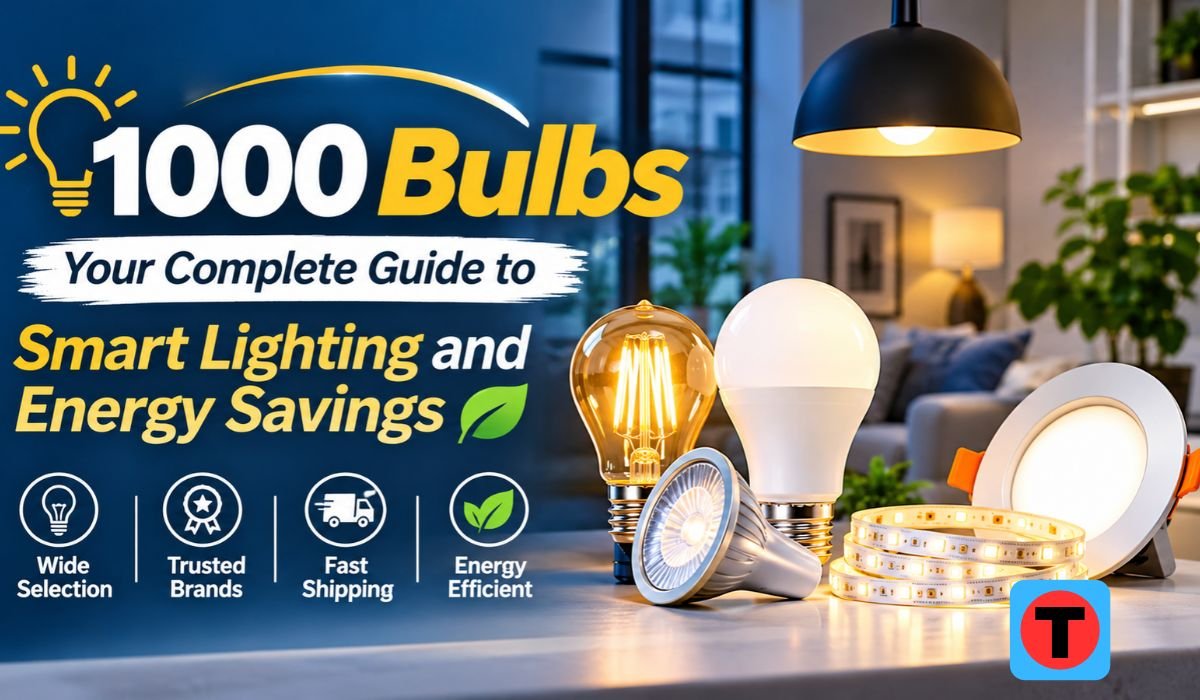
Good lighting does more than brighten a room. It makes homes comfortable, improves visibility, supports everyday activities, and can help reduce electricity costs. Whether you’re upgrading your kitchen lights, improving office lighting, or searching for energy-efficient bulbs, choosing the right products makes a noticeable difference.
1000 Bulbs, widely known as 1000Bulbs.com, is an online lighting retailer with a long history in the lighting industry. The company is associated with LED bulbs, lighting fixtures, commercial lighting solutions, and educational resources that help customers understand different technologies.
As energy efficiency and smart lighting become increasingly important in 2026, understanding brightness, wattage, color temperature, and product compatibility can help buyers avoid expensive mistakes. This guide explores the history of 1000 Bulbs, lighting technologies, practical buying advice, and ways to improve lighting efficiency.
What Is 1000 Bulbs?
1000 Bulbs is an online lighting retailer that serves customers looking for residential, commercial, and specialized lighting products. Its website also provides educational information about lighting technologies, installation considerations, energy efficiency, and product selection.
The company’s educational blog brings together knowledge from technical specialists, sales professionals, and content writers. Its articles explain traditional lighting methods, newer technologies, DIY projects, and hydroponic growing techniques.
For homeowners, this information can simplify decisions about replacing old bulbs or improving room lighting. Businesses can use similar knowledge to evaluate lighting performance, maintenance needs, and operating expenses.
Rather than choosing a product based only on price, shoppers can learn to compare important specifications and select lighting that suits their space.
The History and Growth of 1000 Bulbs
The story of 1000 Bulbs began before online shopping became common. Founder Kim Pedersen entered the lighting industry in 1979 after responding to an advertisement for a sales position.
Working from Elkhorn, Nebraska, he sold lighting products door-to-door throughout the Midwest. In 1982, he relocated to Dallas, Texas, to work for a national lighting distributor.
Pedersen established his own business in 1994 using personal savings. He operated from a spare room, using an old door supported by sawhorses as a desk. Invoices were prepared on a typewriter, and much of his administrative work took place after a full day of selling.
In 1995, he began exploring the Internet as a commercial opportunity. The following year, 1000Bulbs.com launched.
The company describes its subsequent growth as significant, reflecting its transition from a home-based operation into an established online lighting business.
Quick Bio Information About 1000 Bulbs
| Company Information | Details |
|---|---|
| Company Name | 1000Bulbs.com |
| Common Name | 1000 Bulbs |
| Founder | Kim Pedersen |
| Business Established | 1994 |
| Website Launched | 1996 |
| Industry | Lighting Retail |
| Business Type | Online Lighting Retailer |
| Early Business Location | Dallas, Texas |
| Founder’s Early Career | Lighting Sales |
| Founder’s Industry Entry | 1979 |
| Online Business Exploration | 1995 |
| Primary Focus | Lighting Products and Solutions |
| Educational Resource | 1000Bulbs.com Blog |
| Blog Contributors | Technical, Sales, and Content Specialists |
| Educational Topics | LEDs, Lighting Design, DIY Projects |
| Additional Blog Topic | Hydroponics |
| Featured Blog Writer | Angela Rogers |
| Intended Customers | Homeowners and Businesses |
| Guest Posting Policy | Not Accepted According to the Supplied Company Article |
| Company Background | Independent Business Founded by Kim Pedersen |
Exploring Lighting Products at 1000 Bulbs
Lighting needs vary depending on the building, environment, and intended purpose. A bedroom requires a different lighting approach from a warehouse, while outdoor fixtures must handle conditions that ordinary indoor lights may not tolerate.
1000 Bulbs is associated with lighting categories such as LED bulbs, fixtures, decorative lighting, and commercial solutions. Buyers should check its current catalog to confirm particular products and specifications.
LED bulbs are useful for everyday illumination, while specialized fixtures can provide focused or widespread light. Decorative products help create atmosphere, and commercial lighting equipment is designed for more demanding environments.
When comparing products, customers should examine brightness, electrical requirements, physical dimensions, expected lifespan, and fixture compatibility.
Choosing suitable lighting involves more than selecting a familiar bulb shape. The correct product should match both the space and its practical requirements.
Understanding LED Lighting and Its Benefits
LED stands for Light-Emitting Diode, a technology that produces light using semiconductor materials. Unlike incandescent bulbs, which create light by heating a filament, LEDs convert electrical energy into light more efficiently.
One major advantage is lower electricity consumption. According to established U.S. Department of Energy guidance, residential LEDs can use substantially less energy than traditional incandescent lighting.
LED products also generally last longer, although actual performance depends on quality, operating temperature, usage, and electrical conditions.
Another benefit is flexibility. LEDs are available in different brightness levels, color temperatures, and designs, making them suitable for many residential and commercial applications.
However, not every LED works with every fixture. Buyers should confirm dimmer compatibility, voltage requirements, and whether the bulb is rated for enclosed fixtures when necessary.
How 1000 Bulbs Can Help With Energy Savings
Energy savings begin with understanding how much electricity a light consumes. Wattage measures electrical power, while lumens measure the amount of visible light produced.
A traditional 60-watt incandescent bulb can often be replaced by an LED using approximately 8 to 10 watts while delivering similar brightness.
Consider a light used for five hours daily. Replacing a 60-watt bulb with a 9-watt LED reduces consumption by approximately 93 kilowatt-hours annually.
Actual financial savings depend on local electricity rates and usage.
For businesses operating many fixtures, the combined reduction can be substantial. Longer-lasting bulbs may also reduce maintenance and replacement expenses.
The educational resources associated with 1000 Bulbs can help shoppers understand these comparisons and make more informed lighting decisions.
Smart Lighting Solutions for Modern Homes
Smart lighting adds convenience and control to everyday illumination. Depending on the equipment, users can adjust brightness, change colors, create schedules, or control lights remotely.
Some smart bulbs connect through Wi-Fi, while others use compatible wireless systems or dedicated hubs.
Motion sensors can activate lighting when someone enters a room. Timers can switch lights off automatically, helping reduce unnecessary electricity consumption.
Smart lighting is particularly useful in hallways, bedrooms, outdoor areas, and frequently used living spaces.
However, smart bulbs do not automatically guarantee lower energy bills. Savings depend on their efficiency, standby consumption, and how effectively automation reduces unnecessary usage.
When exploring smart lighting products through 1000 Bulbs or another retailer, shoppers should confirm compatibility with their existing switches, networks, and control systems.
Choosing the Right Bulbs for Your Home
Selecting the right bulb becomes easier when you understand a few basic lighting specifications.
Lumens indicate brightness. A higher lumen rating generally means more light, while wattage tells you how much electricity the product consumes.
Color temperature, measured in Kelvin, affects the appearance of illumination. Warm white lighting creates a softer atmosphere, while cooler white lighting may suit detailed tasks.
Bedrooms and living rooms often benefit from warmer tones. Kitchens, workspaces, and utility areas may require brighter task lighting.
The bulb’s base is equally important. A product must fit the socket and meet the fixture’s electrical requirements.
Buyers should also consider beam angle, dimming capability, color rendering, and whether a fixture is suitable for damp or wet environments.
These details help prevent compatibility problems and disappointing lighting results.
Commercial and Industrial Lighting Solutions
Commercial lighting must balance visibility, comfort, operating costs, and maintenance requirements.
Offices need illumination that supports reading and computer work without excessive glare. Retail environments use lighting to improve product visibility and create welcoming spaces.
Warehouses and industrial buildings often require high-output fixtures positioned to illuminate large areas effectively.
LED lighting can be valuable in these settings because efficient equipment may reduce electricity consumption and maintenance demands.
Businesses should evaluate fixture placement, operating hours, lighting controls, and required illumination levels before upgrading.
Professional lighting assessments may be appropriate for large or technically demanding projects.
The broader lighting knowledge available through 1000 Bulbs can help business buyers understand terminology and compare possible solutions before making purchasing decisions.
Indoor and Outdoor Lighting Design Ideas
Thoughtful lighting design can improve how a space looks and functions.
Indoor lighting typically combines ambient illumination, task lighting, and accent lighting. Ambient light provides general brightness, task lighting supports specific activities, and accent lighting highlights decorative features.
A kitchen might combine ceiling fixtures with under-cabinet lighting. A living room could use overhead lighting alongside table lamps and subtle decorative illumination.
Outdoor lighting requires additional consideration. Fixtures should have suitable environmental ratings and be positioned to improve visibility without creating unnecessary glare.
Pathways, entrances, patios, and gardens may benefit from different brightness levels and fixture designs.
Effective lighting design focuses on comfort and purpose rather than simply installing the brightest products available.
Hydroponics and Grow Lighting Resources
Hydroponics is another subject covered by the 1000Bulbs.com educational blog.
Hydroponic systems grow plants using water-based nutrient solutions rather than conventional soil. These systems can be used in controlled growing environments where lighting plays an important role.
Plants require suitable light intensity, duration, and spectrum for healthy development. LED grow lights can provide targeted illumination while offering energy-efficiency advantages over some older technologies.
However, plant requirements vary considerably. Leafy greens, herbs, and fruiting plants may need different growing conditions.
Hydroponic systems can also reduce water consumption in certain applications, particularly when water is recirculated.
Successful growing depends on proper system management, nutrient balance, temperature, and lighting rather than any single piece of equipment.
Educational Guides and DIY Projects From 1000 Bulbs
One of the distinguishing features of 1000 Bulbs is its emphasis on lighting education.
The company’s blog covers lighting terminology, practical techniques, product guidance, DIY projects, and hydroponics.
These resources are intended to help readers understand how lighting works and how different technologies can be used effectively.
The supplied company article identifies Angela Rogers as a Digital Content Specialist with a business management background and interests in DIY projects, gardening, and photography.
Educational content can be especially useful for first-time buyers who find technical product descriptions confusing.
Readers can learn why brightness differs from wattage, how color temperature changes a room’s appearance, and what to consider before replacing fixtures.
For electrical modifications, however, professional assistance may be necessary to ensure safety and code compliance.
How to Shop on 1000Bulbs.com
Shopping for lighting products online requires careful attention to specifications.
Begin by identifying the purpose of the light and the type of fixture being used. Next, determine the required brightness, preferred color temperature, and electrical compatibility.
Product descriptions should be reviewed for dimensions, bulb bases, dimming capabilities, and environmental ratings.
Price comparisons should consider operating costs as well as the initial purchase price. A more efficient product may cost more initially but use less electricity over time.
Before ordering, shoppers should confirm current shipping charges, delivery availability, return conditions, and warranty coverage.
Businesses purchasing multiple products should also consider consistency across fixtures and the availability of suitable replacements.
A little research before purchasing can prevent unnecessary expenses and installation problems.
Is 1000Bulbs.com a Legitimate Lighting Retailer?
1000Bulbs.com has a documented business history dating to 1994, with its online website launching in 1996.
This established history provides useful background for customers researching the company.
However, business longevity alone does not guarantee that every purchase will meet expectations.
Shoppers should examine current product descriptions, payment security, return policies, warranty terms, and available customer support.
Independent customer feedback may also provide useful context, particularly when reviews describe specific purchases and service experiences.
Customers placing large commercial orders should confirm availability, delivery arrangements, and any special purchasing conditions directly with the retailer.
Evaluating these practical details is more useful than relying entirely on promotional claims or general reputation.
The Future of LED and Smart Lighting Technology
Lighting technology continues to evolve as manufacturers improve efficiency, control systems, and product design.
Modern LED development focuses on producing useful illumination with less electricity while maintaining suitable color quality and reliability.
Connected lighting systems are also becoming more sophisticated, allowing users to combine scheduling, sensors, and automated controls.
For businesses, lighting upgrades may increasingly involve integrated energy management rather than simple bulb replacement.
Sustainability remains important, but buyers should consider durability, repairability, responsible disposal, and total operating costs alongside energy efficiency.
In 2026, the smartest lighting choice is not necessarily the newest product. It is the solution that provides dependable illumination, suitable functionality, and reasonable long-term value.
FAQs About 1000 Bulbs
What Is 1000 Bulbs?
1000 Bulbs is an online lighting retailer known as 1000Bulbs.com. It provides lighting-related products and educational resources covering LED technology, lighting design, energy efficiency, and practical applications.
Who Founded 1000Bulbs.com?
Kim Pedersen founded the business in 1994 after gaining experience in lighting sales and distribution. He began exploring online commerce in 1995 and launched 1000Bulbs.com in 1996.
Does 1000 Bulbs Offer LED Lighting?
1000 Bulbs is associated with LED lighting products and educational content. Customers should review the current product catalog to confirm available bulb types, fixtures, specifications, and compatible accessories.
Can LED Bulbs Reduce Electricity Bills?
Yes. Efficient LED bulbs generally consume considerably less electricity than traditional incandescent bulbs producing similar brightness. Actual savings depend on wattage differences, daily operating hours, and electricity prices.
What Is the Difference Between Lumens and Watts?
Lumens measure visible light output, while watts measure electrical power consumption. When selecting efficient lighting, shoppers should compare brightness and energy use separately rather than assuming higher wattage always means better illumination.
Are Smart Bulbs Better Than Regular LED Bulbs?
Smart bulbs offer additional features such as remote control, scheduling, and adjustable settings. Regular LEDs can provide excellent energy efficiency without connectivity. The better option depends on convenience, compatibility, budget, and intended use.
Does 1000 Bulbs Provide Lighting Guides?
Yes. The company’s blog includes educational material about lighting technologies, practical techniques, DIY projects, terminology, and hydroponics. These resources can help readers understand lighting choices before purchasing products.
Does 1000Bulbs.com Accept Guest Posts?
The supplied company article states that 1000Bulbs.com does not accept guest posts. Because editorial policies can change, anyone interested in contributing should confirm the current policy directly with the company.
Final Thoughts
1000 Bulbs represents a combination of lighting retail experience and educational resources developed from a business founded by Kim Pedersen in 1994.
Its history highlights the transition from traditional lighting sales to online commerce, while its blog helps readers understand technologies and practical lighting applications.
For homeowners and businesses, the most important lesson is that effective lighting requires more than choosing an attractive bulb. Brightness, energy consumption, compatibility, color temperature, and long-term costs all influence the result.
Whether you’re upgrading a single room or planning a larger commercial lighting project, understanding these factors can help you make better decisions.
1000 Bulbs offers a useful starting point for exploring lighting products and learning how thoughtful lighting choices can improve comfort, functionality, and energy efficiency.
Learn more and explore exciting content on: RSVPify: A Complete Guide to Smarter Event Planning and Guest Management











Leave a Reply