
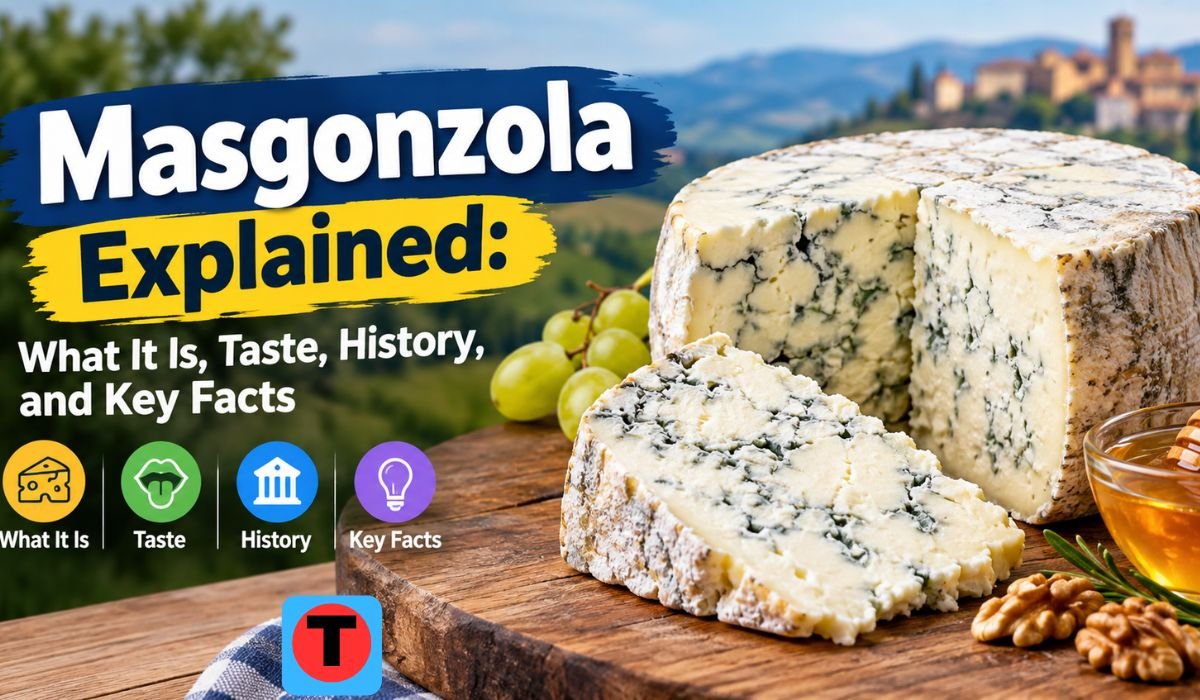
Masgonzola is an unusual food name that can leave even cheese lovers wondering what they are looking at. It sounds like the name of a traditional Italian cheese, and the word clearly resembles Gorgonzola. But Masgonzola is better understood through the two cheeses conne cted to its name: Gorgonzola and Mascarpone. A documented Betty Bossi recipe describes Masgonzola as a creamy Italian soft cheese with alternating layers of Gorgonzola and Mascarpone, and another Betty Bossi recipe recommends using 200 grams of Masgonzola instead of separate Gorgonzola and Mascarpone in risotto.
That makes Masgonzola particularly interesting. It combines the distinctive savory and tangy character of blue-veined Gorgonzola with the smooth, rich quality of Mascarpone. At the same time, it is important not to confuse this combination with Gorgonzola itself. Gorgonzola has a clearly documented history and Protected Designation of Origin, while Masgonzola does not have the same separately established PDO identity. This guide explains what Masgonzola is, how it tastes, where its story comes from, how it can be used, and what readers should know when buying or eating it.
Quick Facts About Masgonzola
Name: Masgonzola
Main Components: Gorgonzola And Mascarpone
Food Type: Creamy Italian Soft-Cheese Preparation
Main Flavor: Rich, Creamy, Savory, Tangy, And Mildly Pungent
Texture: Soft, Smooth, And Spreadable
Appearance: Creamy With Possible Blue-Green Gorgonzola Veining
Gorgonzola Connection: Main Blue-Cheese Component
Mascarpone Connection: Main Creamy Component
Italian Connection: Strongly Linked To Italian Cheese Traditions
Protected Status: Gorgonzola Has PDO Status; Masgonzola Does Not Have The Same Separate PDO Recognition
Common Uses: Risotto, Pasta, Ravioli, Sauces, Pizza, Bread, Crackers, And Cheese Boards
Popular Pairings: Pears, Figs, Grapes, Honey, Walnuts, And Bread
Dairy Content: Contains Milk Ingredients
Flavor Intensity: Depends On The Balance Of Gorgonzola And Mascarpone
Nutrition: Varies According To The Specific Product Or Preparation
Storage: Refrigerated
Main Appeal: Blue-Cheese Flavor Combined With Extra Creaminess
What Is Masgonzola?
Masgonzola is generally used to describe a creamy combination of Gorgonzola and Mascarpone. One useful piece of evidence comes directly from Betty Bossi, which describes Masgonzola as an Italian soft cheese made with alternating layers of Gorgonzola and Mascarpone. This gives the term a more concrete culinary meaning than simply treating it as an invented name.
The combination makes sense from a flavor and texture perspective. Gorgonzola brings the characteristic qualities of blue-veined cheese, including savory depth, saltiness, tang, and a recognizable aroma. Mascarpone is much softer and milder, contributing richness and creaminess. An Italian dairy producer, Consorzio Virgilio, describes Mascarpone as having a delicate taste and a texture associated with fresh cream.
Because the name is uncommon, it is easy to assume Masgonzola is simply another variety of Gorgonzola. It is not. The addition of Mascarpone changes the character of the food and is central to understanding what Masgonzola means in culinary use.
What Does The Name Masgonzola Mean?
The name itself offers a useful clue. “Mas” can be associated with Mascarpone, while “Gonzola” points toward Gorgonzola. In that sense, Masgonzola is a name that reflects the combination of its two main components.
This also explains why the term can be confusing online. A reader who sees the word without any context might reasonably think it describes a famous regional cheese with centuries of documented production rules. The available culinary evidence supports a more careful explanation: Masgonzola is associated with a creamy preparation involving Gorgonzola and Mascarpone.
That distinction is important for accurate food writing. Gorgonzola has an official PDO specification that defines the product, its characteristics, raw materials, production area, and maturation categories. Masgonzola should not automatically be given the same official status simply because its name contains “Gorgonzola.”
The History Behind Masgonzola
There is not enough reliable evidence to present Masgonzola as an ancient, independently documented cheese tradition. Its story is better understood by looking at the two established Italian dairy products behind it.
Gorgonzola has a long history. The Gorgonzola Protection Consortium traces the cheese’s roots back to the ninth century and connects its development with northern Italian territories. The consortium notes that the cheese became formally recognized as a designation of origin in Italy in 1955, while the European Union registered Gorgonzola as a PDO product in 1996.
Its geographical connection remains important today. The official consortium states that Gorgonzola PDO production is tied to designated provinces in Piedmont and Lombardy, with specific requirements concerning the milk and production area. Mascarpone has its own long-standing place in Italian dairy culture and is valued for its delicate, creamy character.
Masgonzola therefore makes the most sense as a meeting point between two established ingredients rather than as a cheese with a separate ancient origin story.
Is Masgonzola A Traditional Italian Cheese?
This question needs a careful answer. Masgonzola has documented culinary use as a creamy Italian soft-cheese preparation involving Gorgonzola and Mascarpone, but it should not be described as though it has the same standardized legal identity as Gorgonzola PDO.
The European Union specification for Gorgonzola identifies it as a PDO cheese made from pasteurized whole cow’s milk and defines its appearance, maturation, and other characteristics. The Gorgonzola Consortium also explains that the cheese’s production is regulated and linked to a defined geographical territory.
Masgonzola is different. Its documented culinary identity is based on the combination of Gorgonzola and Mascarpone, and preparations can differ. This is why it is safer to call it a cheese combination, specialty, or preparation rather than suggesting that every Masgonzola product follows one universal official formula.
Is Masgonzola The Same As Gorgonzola?
No. Although Gorgonzola is central to Masgonzola, the two names describe different things.
Gorgonzola is an established Italian blue-veined cheese. European Union documentation describes its characteristic blue-green or grey-blue veining and identifies several maturation categories, including mild and stronger styles. Masgonzola adds Mascarpone to the equation, creating a softer and richer overall preparation.
The difference is easiest to understand through texture. Gorgonzola can be creamy, but it retains the identity of a blue cheese with its own regulated production characteristics. Masgonzola is designed around the contrast between Gorgonzola’s stronger flavor and Mascarpone’s smoothness.
So, while the names are related, Masgonzola should not be used as a simple synonym for Gorgonzola.
Masgonzola vs. Mascarpone
Mascarpone on its own is mild, rich, and creamy. It is commonly associated with Italian desserts such as tiramisu, but its soft texture also makes it useful in savory dishes. Consorzio Virgilio describes its Mascarpone as delicate and naturally reminiscent of fresh cream.
Masgonzola has a very different personality because Gorgonzola supplies a stronger savory element. The Mascarpone softens and enriches that character rather than replacing it.
This is what makes the combination useful. Someone who enjoys creamy cheeses may appreciate the richness of Masgonzola, while someone interested in blue cheese can experience Gorgonzola’s distinctive flavor in a softer setting. The balance depends on how the two components are combined.
What Does Masgonzola Taste Like?
Masgonzola can be described as creamy, rich, savory, tangy, salty, buttery, and mildly pungent, although the exact flavor depends on the particular preparation. The Gorgonzola component supplies most of the blue-cheese character, while Mascarpone contributes a gentle dairy richness.
The result can feel smoother than eating Gorgonzola alone. Instead of one strong flavor dominating the palate, the combination allows creamy and savory notes to work together. A preparation with a greater influence from Gorgonzola may have a more pronounced blue-cheese character, while one with more Mascarpone can feel softer and milder.
This variation is one reason readers should avoid assuming that every Masgonzola product will taste exactly the same. Unlike Gorgonzola PDO, which has defined product requirements, the Masgonzola name can describe a combination whose proportions and presentation vary.
What Is The Texture And Appearance Of Masgonzola?
Texture is one of Masgonzola’s most appealing qualities. Mascarpone naturally provides a smooth, rich consistency, while Gorgonzola contributes the characteristic appearance and flavor associated with blue-veined cheese.
Betty Bossi’s documented description is particularly helpful here because it describes Masgonzola as a creamy Italian soft cheese with alternating layers of Gorgonzola and Mascarpone. That means the appearance may show a noticeable contrast between pale creamy sections and areas containing the blue-cheese component.
The final texture can be soft and spreadable, making Masgonzola suitable for bread, crackers, fillings, and sauces. Depending on the preparation, the two components may remain visibly distinct rather than becoming completely uniform.
How Is Masgonzola Made?
There is no single universally documented Masgonzola production standard comparable to the official Gorgonzola PDO specification. The clearest culinary evidence describes a preparation in which Gorgonzola and Mascarpone are arranged in alternating layers.
That distinction matters. It means readers should not expect every product or preparation called Masgonzola to have exactly the same appearance, proportions, or nutritional profile.
Gorgonzola itself has carefully defined production requirements. The EU specification describes it as a blue-veined cheese made from pasteurized whole cow’s milk, with specific maturation periods depending on the product category. Masgonzola builds on that established cheese by introducing Mascarpone’s creamy qualities.
How To Use Masgonzola In Cooking
Masgonzola is especially useful when a recipe needs both strong cheese character and creaminess. One of the clearest examples is risotto. Betty Bossi has a Gorgonzola risotto recipe that combines Gorgonzola and Mascarpone and specifically suggests replacing the two cheeses with 200 grams of Masgonzola.
It can also work in filled pasta, sauces, spreads, pizza, flatbreads, crostini, and other savory dishes. Another Betty Bossi recipe uses Masgonzola in a ham-filled pasta preparation, showing that its use extends beyond risotto.
Its creamy nature makes it particularly practical in dishes where cheese needs to blend smoothly. Instead of adding a separate blue cheese and creamy ingredient, Masgonzola can provide both qualities in one preparation.
Best Foods To Pair With Masgonzola
Masgonzola works well with foods that create contrast. Sweet fruit is particularly useful because its natural sweetness can balance the salty and tangy character of Gorgonzola.
Pears, figs, grapes, and honey are natural choices for a cheese board or appetizer. Walnuts can add a pleasant nutty contrast, while bread and crackers provide a neutral base that lets the cheese remain the focus.
The same principle works in cooked dishes. A creamy Masgonzola sauce can add richness to pasta, while a small amount on pizza or toasted bread can provide a concentrated savory element. Because the cheese itself is rich, pairing it with fresh fruit or crisp vegetables can help create a more balanced bite.
Masgonzola Nutrition And Dietary Considerations
There is no single nutrition profile that applies to every Masgonzola preparation. The nutritional content depends on the specific ingredients, proportions, serving size, and product formulation.
For comparison, Betty Bossi lists its Gorgonzola risotto containing Gorgonzola and Mascarpone at 601 calories, 29 grams of fat, 59 grams of carbohydrates, and 14 grams of protein per quarter serving. Those figures belong to the complete risotto recipe, not Masgonzola itself, so they should not be treated as a nutrition label for the cheese.
The practical point is that Masgonzola is a rich dairy food. Anyone watching calories, saturated fat, or sodium should check the specific package rather than relying on a generic number. People with milk allergies should also avoid it because its principal components are dairy products. Those managing lactose intolerance or another dietary restriction should check the individual product label for appropriate information.
How To Store Masgonzola Properly
Masgonzola should be treated as a perishable refrigerated dairy product. The safest approach is to follow the storage instructions provided by the producer, especially because different preparations can have different packaging and shelf-life requirements.
After opening, keep the cheese properly covered and refrigerated. Clean utensils are useful when spreading or portioning it, and the cheese should not be left at room temperature for longer than necessary.
There is no single shelf-life number that should be applied to every Masgonzola product. The package’s use-by or best-before information is more useful than a general online estimate. If the appearance, smell, or texture changes noticeably beyond what is expected for the product, it is sensible to follow food-safety guidance and the manufacturer’s instructions.
Why Is Masgonzola Interesting To Cheese Lovers?
The biggest attraction of Masgonzola is contrast. Gorgonzola supplies a distinctive blue-cheese identity, while Mascarpone adds a smooth, rich quality. Together, they create something that is both familiar and unusual.
The combination is also practical. A cook can use it in risotto, pasta, ravioli, sauces, appetizers, or on a cheese board. Betty Bossi’s recipes demonstrate that the name is used in real culinary contexts rather than existing only as an obscure internet term.
For readers discovering Masgonzola in 2026, perhaps the most useful perspective is to focus on what is actually documented. Gorgonzola has a clearly protected identity and long history. Mascarpone has its own established Italian dairy tradition. Masgonzola brings those two qualities together in a creamy preparation that can be used in several ways.
Common Misconceptions About Masgonzola
One common misunderstanding is that Masgonzola is simply another name for Gorgonzola. It is not. The presence of Mascarpone is central to the documented culinary description of Masgonzola.
Another misconception is that Masgonzola necessarily has an ancient history identical to Gorgonzola. There is strong documentation for the long history of Gorgonzola, including its roots dating back centuries and its formal designation history. That evidence should not automatically be transferred to Masgonzola.
It is also unhelpful to assume that every Masgonzola product has exactly the same proportions or nutrition. The available evidence points to a culinary preparation rather than a single PDO specification. Readers are therefore better served by checking the actual product information when buying it.
Final Thoughts
Masgonzola is much easier to understand once its two main components are recognized. It is generally associated with Gorgonzola and Mascarpone, combining the savory, tangy character of blue cheese with the rich and creamy quality of Mascarpone. Documented Betty Bossi recipes provide practical evidence of the term’s culinary use, including its role as a substitute for separate Gorgonzola and Mascarpone in risotto.
The important distinction is that Masgonzola should not be confused with Gorgonzola PDO. Gorgonzola has a long documented history, a defined production area, and European PDO recognition. Masgonzola is better described as a creamy cheese combination or specialty preparation.
For anyone who enjoys discovering unusual Italian cheese products, that combination is exactly what makes Masgonzola worth exploring. It offers the depth of Gorgonzola while bringing in the softness and richness of Mascarpone, making it useful at the dinner table as well as on a simple cheese board.
FAQs About Masgonzola
What Is Masgonzola?
Masgonzola is generally associated with a creamy combination of Gorgonzola and Mascarpone. Betty Bossi describes it as an Italian soft cheese with alternating layers of Gorgonzola and Mascarpone. It can therefore provide both blue-cheese flavor and a rich, creamy texture.
Is Masgonzola The Same As Gorgonzola?
No. Gorgonzola is an established Italian blue-veined cheese with PDO protection and defined production requirements. Masgonzola incorporates Mascarpone and is better understood as a combination or specialty preparation rather than another name for Gorgonzola.
What Does Masgonzola Taste Like?
Masgonzola generally combines the creamy and mild qualities of Mascarpone with the salty, savory, tangy, and blue-cheese character of Gorgonzola. The exact intensity can change according to the proportions and the particular Gorgonzola used.
Is Masgonzola A Protected Italian Cheese?
Gorgonzola has European PDO recognition, but Masgonzola does not have the same separately established PDO identity in the official material consulted for this article. It is more accurate to describe Masgonzola as a culinary cheese combination associated with Gorgonzola and Mascarpone.
How Can You Eat Masgonzola?
Masgonzola can be used in risotto, pasta, filled pasta, sauces, pizza, spreads, appetizers, bread, and cheese boards. Betty Bossi specifically recommends it as an alternative to separate Gorgonzola and Mascarpone in a risotto recipe.
What Goes Well With Masgonzola?
Sweet and fresh foods can create a pleasant contrast with its rich and savory flavor. Pears, figs, grapes, honey, and walnuts are natural cheese-board pairings, while bread and crackers provide a simple base. It can also work well in rich pasta and risotto dishes.
Does Masgonzola Contain Milk?
Yes. The combination is based on Gorgonzola and Mascarpone, both dairy products. Anyone with a milk allergy should avoid it, while people with lactose intolerance or other dietary restrictions should check the ingredients and allergen information on the specific product.
How Should Masgonzola Be Stored?
Masgonzola should be refrigerated and kept properly covered after opening. Because different products and preparations can have different shelf lives, the manufacturer’s storage instructions and package date should be followed rather than relying on one universal storage period.
Learn more and explore exciting content on: Brasssmile Explained: Meaning, Causes, Treatments, and Safety Guide





Leave a Reply