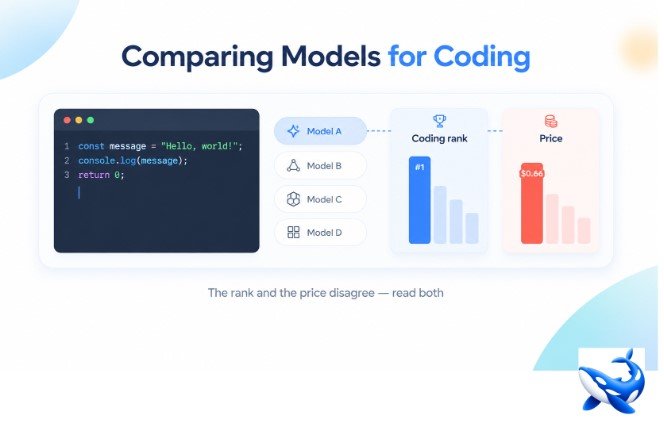
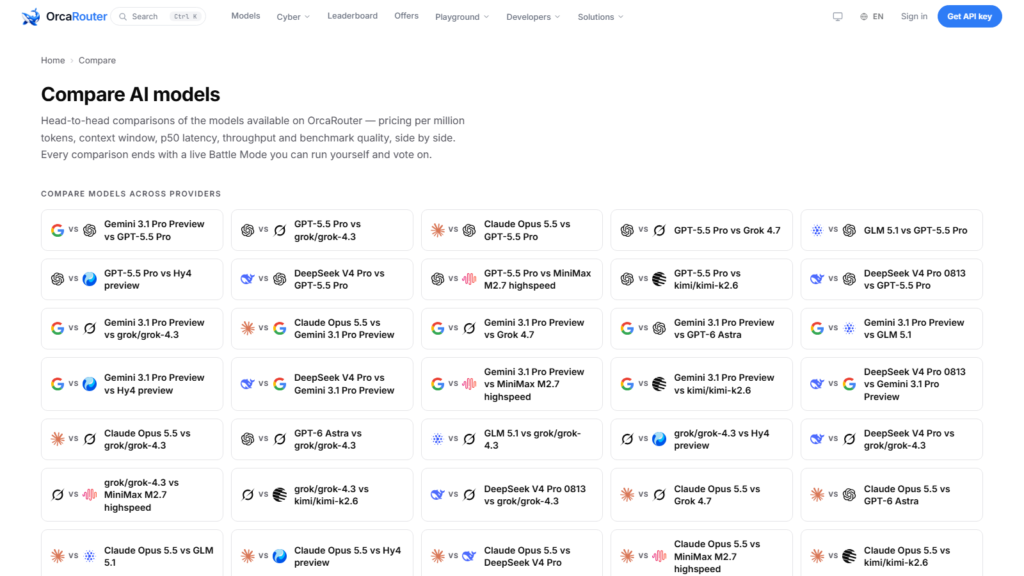
Put three engineers in a room with a model comparison page and within a minute someone will ask which row is the best coder. The honest answer is that the question has two halves that point at different rows, and the page on OrcaRouter makes both halves visible at once: an independent coding rank, and a price column that disagrees with it. This llm model comparison carries twelve rows, and the coding decision is mostly a matter of knowing which of its columns deserve your time — and which one deserves to be ignored until last.
A coding comparison is a filter, not a ranking.
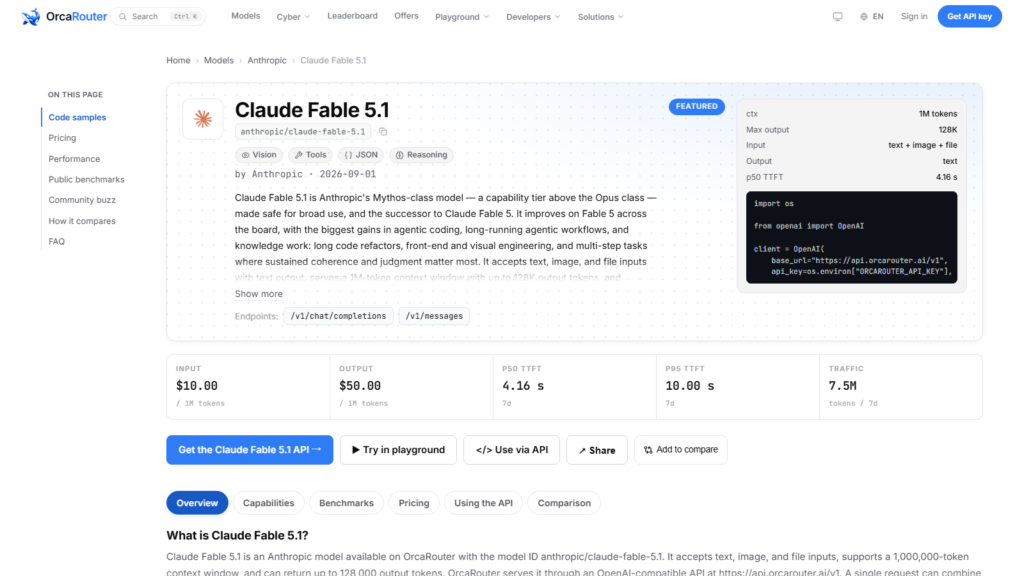
Start with the column that made you click. On the independent benchmark aggregator we read for this article, Claude Fable 5.1 posts the top coding score of 81.6, ranked first out of 138 models. The highest intelligence reading anywhere in this twelve-row table belongs to a different model: Claude Opus 5.5 at 57.6, ranked fourth out of 147. Same table, two different leaders, and neither claim is wrong. If the page in front of you is a coding comparison, the coding column is the one that answers, and in this table that column crowns Fable 5.1. The same aggregator places the rest of the field well below: Gemini 3.1 Pro Preview at 68.8 and DeepSeek V4 Pro at 68.8, both ranked 30th of 138, with GPT-5.4 at 71.1 in 24th.
Now sort the same rows by price and the picture flips. Claude Fable 5.1 charges $10.00 input and $50.00 output per million tokens, the second dearest input card on the page. DeepSeek V4 Pro, with its equal coding score of 68.8, charges $0.66 input and $1.98 output. Gemini 3.1 Pro Preview, also 68.8, charges $2.00 / $12.00. A coding rank and a price rank disagree because they answer different questions: one measures what a model does on a standard task set, the other measures what it costs to run a workload. An engineer who asks which model writes better code and an accountant who asks which model is cheaper are looking at the same table and will correctly walk away with different winners.
The composite quality score: our own column, read correctly
The table also carries a composite quality score, and a coding buyer has to read it with its definition attached. It is our own in-house 0–10, scored across reasoning, instruction-following and reliability — not a third-party benchmark and not a coding test. In this table, Claude Fable 5.1 and Gemini 3.1 Pro Preview both sit at 10.0, and nine of the twelve rows land at 8.0 or 9.0, so the column does almost none of the differentiation a coding shortlist needs. The quality score answers “which model is broadly strong,” and it is too coarse to answer “which model should review my pull request.” Use it as a floor — drop nothing below 8.0 if you can avoid it — and then stop consulting it, because the coding rank and the price column will do the real work.
One trap lives inside the composite column: the models that share a score are not interchangeable, and the models that differ are not cleanly ordered. DeepSeek V4 Pro at $0.66 and kimi-k2.6 at $0.95 both earn 8.0, and so does MiniMax M2.7 highspeed at $0.60, yet their coding ranks on the independent aggregator differ by more than the composite column can show. Score equality is a statement about our composite dimensions, not a promise about your workload.
The columns a coding decision should actually use
Rank the columns by how much they move a coding decision, and the table sorts itself. First, the coding rank itself: an independent score with its denominator attached, because a rank of 30 out of 138 means something different from a rank of 30 out of 50. Second, the output price, because code generation is write-heavy: every answer is a long completion, and a row like Claude Fable 5.1 at $50.00 output per million tokens bills the tokens your code actually costs. Third, the context window, because modern coding means pasting in a whole repository: most rows here carry 1M, but Grok 4.7 stops at 500K, kimi-k2.6 at 262K, and MiniMax M2.7 highspeed at 205K, which rules each of them out of repository-scale work before a single prompt is written. GPT-5.5 Pro does not publish its context window at all, which makes it a risk for the same reason. And fourth, the latency column, which only matters once the coder rows qualify but then matters a great deal, because an interactive coding session that waits on a first token is a session a developer will not wait for twice.
The columns that should wait until last are the ones that feel decisive but answer a different question. The p50 first-token latency tells you how fast an interactive session feels, and it belongs in the decision only after the coder-quality and price rows qualify. Two of the twelve rows — Gemini 3.1 Pro Preview and GPT-5.4 — sit pinned at the 10.00 s ceiling, the cap of the measurement window, so their interactive feel is unverified and they deserve a real traffic test before a team builds on them. The seven-day traffic column answers what other people run, which is a market signal, not a quality signal: DeepSeek V4 Pro moved 512.0M tokens in the trailing seven days, dwarfing the dearest cards, but popularity is a reason to test, not a verdict.
Building the shortlist, in order
A defensible coding shortlist falls out of the table in four steps. Drop every row whose context window cannot hold your repository: if the codebase is large, the field shrinks from twelve to the 1M rows. Rank the survivors by the independent coding score, which puts Claude Fable 5.1 at 81.6 first, then GPT-5.4 at 71.1, then the 68.8 pair of Gemini 3.1 Pro Preview and DeepSeek V4 Pro. Split the tie at the top by price, because the $0.66 input and $1.98 output of DeepSeek V4 Pro buys a lot of generated tokens before a $10.00 / $50.00 card even starts. Finally, sanity-check the two finalists against the columns that are cheap to verify: the 10.00 s ceiling on the Preview row means running your own probe before trusting its interactive feel, and the 512.0M seven-day token count on the DeepSeek row says the endpoint is carrying real production load rather than a showcase.
The point of the exercise is that no single column produced that shortlist. The coding rank alone would have ended at Fable 5.1 without asking whether its price survived contact with a write-heavy workload. The price alone would have ended at the cheapest row without asking whether it can hold the codebase. The composite quality score alone would have ended in a four-way tie. Reading the columns in the right order is the entire skill, and a table that prints all of them — the rank with its denominator, the output price, the context window, and the usage column — is a table you can do that with. A table that printed only the benchmark column, or only the price column, would hand you a confident answer that is wrong for a different half of the readers every time, which is why the comparison page that carries the full row set is the only kind worth bookmarking for a coding decision.
The takeaway
A coding comparison is won by reading the columns in the right order, not by finding the tallest bar. The independent coding rank crowns Claude Fable 5.1 at 81.6 of 138, the price column crowns a different set entirely, and the composite quality score — our own in-house 0–10 across reasoning, instruction-following and reliability — is too coarse to decide anything on its own. Rank your rows by coding score inside a context window that fits the repository, break the tie with the output price, and verify the survivors against the latency and traffic columns before you commit. Do that, and the table that looked like a popularity contest becomes a shortlist with a paper trail.









Leave a Reply