
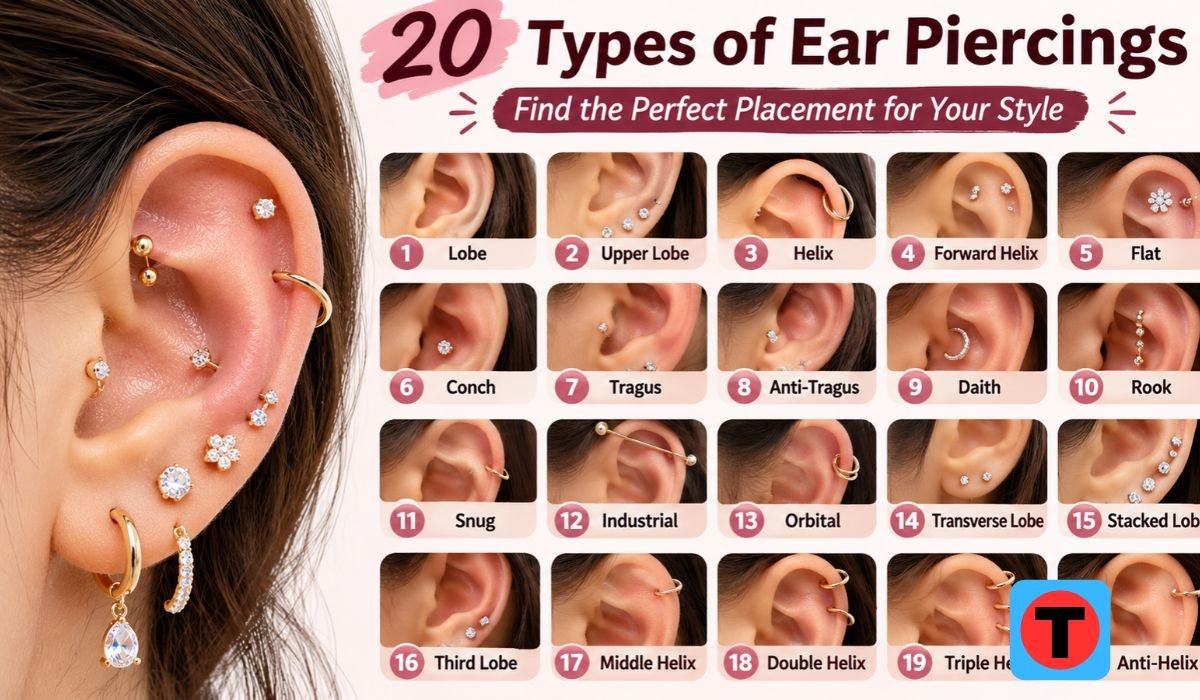
Ear Piercings are more than just a fashion accessory. They offer a creative way to express your personality, highlight your features, and add something special to your everyday appearance. Whether you love delicate gold studs, elegant hoops, or bold cartilage jewelry, there are plenty of styles to explore.
In 2026, styling ideas such as Stacked Lobes, Hidden Helix Piercings, and Curated Ears offer exciting alternatives to traditional earrings. However, choosing the right placement involves understanding pain levels, healing times, jewelry materials, and aftercare requirements.
This guide explores 20 Types of Ear Piercings to help you discover a style that complements your personality, ear anatomy, and lifestyle. Whether you’re getting your first piercing or expanding your collection, you’ll find practical information to make your experience more comfortable and enjoyable.
Quick Bio Information About Ear Piercings
| Feature | Information |
|---|---|
| Topic | Ear Piercings |
| Total Styles Covered | 20 |
| Main Categories | Earlobe and Cartilage Piercings |
| Best Beginner Piercing | Standard Lobe |
| Least Painful Placement | Generally Standard Lobe |
| More Painful Placement | Snug Piercing |
| Earlobe Healing Time | 6–8 Weeks or Longer |
| Cartilage Healing Time | 6–12 Months or Longer |
| Recommended Piercing Method | Sterile, Single-Use Needle |
| Popular Styling Method | Earscaping |
| Common Jewelry | Studs, Hoops, and Barbells |
| Recommended Jewelry Material | Implant-Grade Titanium |
| Recommended Cleaning Solution | Sterile 0.9% Saline |
| Common Complications | Irritation, Infection, and Scarring |
| Piercing Cost | Depends on Placement and Jewelry |
| Jewelry Replacement | After Complete Healing |
| Migraine Relief Claims | Insufficient Scientific Evidence |
| Anatomy Assessment | Strongly Recommended |
| Professional Aftercare | Essential |
| Suitable For | Individuals With Appropriate Anatomy |
What Are Ear Piercings?
Ear Piercings involve creating a small opening through the soft tissue or cartilage of the outer ear to accommodate jewelry. Although commonly associated with modern fashion, piercing has existed across different cultures for centuries, representing beauty, tradition, status, and personal identity. Today, people can choose from numerous placements beyond the traditional earlobe. Some prefer simple earrings, while others create carefully coordinated jewelry arrangements known as Earscaping. This approach allows different studs, hoops, gemstones, and decorative pieces to complement one another. Understanding your natural ear shape is particularly important because not every placement is suitable for everyone. An experienced piercer can recommend options that balance appearance, comfort, and healing requirements.
Ear Piercing Pain and Healing Chart
Understanding Ear Piercing Pain Levels and Healing Times can help you prepare for your appointment. Earlobe Piercings generally cause less discomfort, while thicker cartilage placements may feel more intense and require additional recovery time. The following Ear Piercing Chart provides approximate comparisons rather than guaranteed results.
| Type of Ear Piercing | Estimated Pain | Healing Time |
|---|---|---|
| Standard Lobe | 1/10 | 6–8 Weeks or Longer |
| High-Lobe | 2/10 | 6–8 Weeks or Longer |
| Stacked Lobe | 2/10 | 6–8 Weeks or Longer |
| Transverse Lobe | 6/10 | Several Months |
| Helix | 4/10 | 6–12 Months |
| Forward Helix | 5/10 | 6–12 Months |
| Auricle | 3/10 | 6–12 Months |
| Hidden Helix | 5/10 | 6–12 Months |
| Daith | 5/10 | 6–12 Months |
| Tragus | 5/10 | 6–12 Months |
| Anti-Tragus | 6/10 | 9–12 Months or Longer |
| Rook | 6/10 | 6–12 Months |
| Conch | 4/10 | 6–12 Months |
| Inner Conch | 6/10 | 6–12 Months |
| Outer Conch | 6/10 | 6–12 Months |
| Faux Rook | 5–6/10 | 6–12 Months |
| Industrial | 6/10 | 9–12 Months or Longer |
| Snakebite | 4–6/10 | Depends on Placement |
| Snug | 9/10 | 6–12 Months or Longer |
| Orbital | 4/10 | Depends on Placement |
These pain ratings are subjective estimates from the supplied reference guide, not medically standardized scores. Individual experiences and healing periods can vary considerably.
Standard Lobe, High-Lobe, Stacked Lobe, and Transverse Lobe
The Standard Lobe Piercing remains a timeless choice because of its simplicity and versatility. Positioned in the soft lower portion of the ear, it generally heals faster than cartilage placements. A High-Lobe Piercing sits slightly above the traditional opening, creating additional space for decorative earrings. The Stacked Lobe Piercing involves vertically arranged openings that look particularly attractive with small gemstones and delicate studs. Meanwhile, the Transverse Lobe Piercing travels horizontally through the earlobe rather than from front to back. It typically accommodates a barbell and requires more healing time. These four styles offer something for everyone, from beginners seeking simplicity to individuals wanting a distinctive appearance.
Helix, Forward Helix, Auricle, and Hidden Helix
The Helix Piercing sits along the upper outer edge of the ear and provides an elegant introduction to Cartilage Piercings. A Forward Helix Piercing occupies the front section of the upper cartilage near the head, making it ideal for delicate gemstone studs. The Auricle Piercing, also called a Mid-Helix, sits along the middle outer edge of the ear. It creates a beautiful transition between upper cartilage and lobe jewelry. A Hidden Helix Piercing is positioned beneath the upper cartilage fold, where suitable decorative jewelry can create a floating appearance. All four placements require patience during healing, particularly if you regularly wear headphones, glasses, or protective helmets.
Daith, Tragus, Anti-Tragus, and Rook
The Daith Piercing passes through an inner cartilage fold near the ear canal and is commonly decorated with rings. Despite its reputation as a potential migraine remedy, the American Migraine Foundation does not recommend it as a treatment because reliable scientific evidence is lacking. The Tragus Piercing sits through the small cartilage flap in front of the ear canal, while the Anti-Tragus Piercing occupies the raised cartilage opposite it. The Rook Piercing passes through an internal ridge above the daith and often accommodates a curved barbell. These placements depend heavily on individual anatomy, and some may temporarily interfere with wearing earbuds.
American Migraine Foundation
Conch, Inner Conch, Outer Conch, and Faux Rook
A Conch Piercing occupies the central cartilage bowl of the ear, offering plenty of opportunities for decorative jewelry. The Inner Conch Piercing generally sits deeper within this central area, while the Outer Conch Piercing is positioned farther outward. However, naming conventions vary between studios, and these are related variations rather than completely separate anatomical categories. A Faux Rook Piercing resembles a traditional rook but passes through cartilage from front to back instead of following an internal fold. It can provide a similar visual effect for people with suitable anatomy. Flat-back studs and decorative gemstones work beautifully in many of these placements.
Industrial, Snakebite, Snug, and Orbital
The Industrial Piercing creates a bold appearance by connecting two cartilage openings with a straight barbell. Its success depends on compatible ear anatomy and precise alignment. A Snakebite Ear Piercing describes two closely positioned openings, usually decorated with matching jewelry. The Snug Piercing travels through a firm inner cartilage ridge and is often considered particularly challenging because of swelling and prolonged healing. An Orbital Piercing connects two separate openings using one ring rather than a straight barbell. These designs are visually distinctive, but connected piercings require careful planning because pressure or movement at one opening may affect the other.
Earlobe vs. Cartilage Piercings
Earlobe Piercings and Cartilage Piercings differ considerably in comfort, healing, and maintenance. The earlobe consists primarily of soft tissue, while cartilage is firmer and has a more limited blood supply. As a result, traditional lobe placements generally recover faster. Cartilage Piercings may remain sensitive for several months, especially when exposed to repeated pressure or accidental bumps. Infections involving cartilage can also cause more serious complications, including permanent changes to the ear’s shape. If you’re looking for a relatively straightforward experience, an earlobe placement may be preferable. Cartilage offers more creative possibilities but requires a greater commitment to aftercare.
Best Ear Piercings for Beginners
Standard Lobe, High-Lobe, and Stacked Lobe Piercings are generally excellent starting points when positioned entirely within soft tissue. They provide plenty of styling flexibility without the extended recovery associated with cartilage. A Helix Piercing may also suit beginners who are prepared for a longer healing process. Consider your daily routine before selecting a placement. Sleeping habits, sports, workplace requirements, and frequent headphone use can influence your experience. Starting with a manageable number of piercings allows you to understand how your body responds before expanding your collection.
Ear Piercing Costs in 2026
Ear Piercing Costs vary depending on location, studio reputation, placement complexity, jewelry quality, and professional experience. Traditional Earlobe Piercings are generally less expensive than complex placements such as Industrial or Snug Piercings. Premium materials, solid gold, decorative gemstones, and customized jewelry can increase the final price. Some studios charge separately for piercing services, jewelry, and follow-up adjustments. Before booking, request a complete price estimate, including any necessary downsizing appointments. Choosing an experienced professional who follows proper hygiene standards is more important than finding the cheapest available service.
Best Ear Piercing Jewelry
Choosing suitable Ear Piercing Jewelry is essential for both appearance and healing. Certified implant-grade titanium is an excellent choice for many people, particularly those concerned about nickel sensitivity. Appropriate implant-grade steel, niobium, and qualifying solid gold may also be suitable. Flat-back studs are commonly used for lobe and several cartilage placements, while curved barbells accommodate certain internal cartilage folds. Initial jewelry should have a smooth surface and sufficient space for swelling. Gold-plated pieces, sterling silver, and jewelry of unknown composition should be avoided in fresh piercings. The Association of Professional Piercers provides detailed standards for selecting appropriate initial jewelry.
Association of Professional Piercers
Stylish Ear Piercing Ideas
Creating a Curated Ear allows you to combine individual placements into a coordinated design. Minimalist styles often feature tiny studs, subtle gemstones, and delicate hoops. Stacked Lobes can introduce visual depth, while Double Helix Piercings create balance along the upper ear. A statement hoop in a fully healed Conch Piercing can become the centerpiece of an entire arrangement. Mixing gold and silver tones offers additional contrast, while decorative chains and colorful gemstones introduce personality. Rather than copying every fashionable design, choose jewelry that complements your natural ear shape, wardrobe, and everyday activities.
Essential Ear Piercing Aftercare
Proper Ear Piercing Aftercare helps protect recovering tissue and reduce unnecessary irritation. The Association of Professional Piercers recommends sterile saline wound wash containing 0.9% sodium chloride. Wash your hands before touching the area, avoid rotating jewelry, and follow your piercer’s cleaning instructions. Keep harsh chemicals, rubbing alcohol, hydrogen peroxide, and cosmetics away from healing tissue. Avoid submerging new piercings in swimming pools and hot tubs. Sleeping on the opposite side or using a pillow with an ear opening can reduce pressure. Leave initial jewelry in place unless a qualified piercer determines that an adjustment is necessary.
Association of Professional Piercers
Common Piercing Problems
Mild tenderness, itching, localized swelling, and light crusting can occur during normal healing. However, increasing pain, spreading discoloration, unusual warmth, pus, fever, or chills may indicate an infection. Piercing bumps can also develop because of pressure, unsuitable jewelry, or repeated irritation, although not every bump is a keloid. According to the NHS, suspected piercing infections require prompt medical attention, especially when cartilage is involved. Avoid squeezing bumps or attempting to treat them with harsh products. Do not remove jewelry from a suspected infected piercing unless a healthcare professional advises you to do so.
NHS
Choosing a Safe Piercing Studio
A professional Piercing Studio should prioritize hygiene, customer comfort, and appropriate anatomy assessment. Before the procedure, your piercer should examine your ear, discuss suitable jewelry, explain potential risks, and mark your chosen placement for approval. Sterile, single-use needles are preferable to traditional piercing guns, particularly for cartilage. A trustworthy studio should also provide written aftercare instructions and access to follow-up appointments. If you have a history of keloids, metal allergies, impaired immunity, or conditions affecting wound healing, discuss your plans with a healthcare professional beforehand. A responsible piercer will never pressure you into an unsuitable placement.
Association of Professional Piercers
Final Thoughts
Exploring these 20 Types of Ear Piercings reveals just how many creative possibilities exist beyond traditional earrings. From elegant Stacked Lobes to distinctive Hidden Helix and Industrial Piercings, every placement offers its own character.
However, the perfect piercing isn’t necessarily the most fashionable one. It’s the placement that suits your anatomy, complements your personal style, and fits comfortably into your lifestyle.
Choose an experienced piercer, invest in high-quality jewelry, and give your body enough time to heal. By approaching Ear Piercings with patience and thoughtful planning, you can create a beautiful, personalized collection that you’ll enjoy for years.
FAQs About 20 Types of Ear Piercings
Which Ear Piercing Hurts the Least?
The Standard Lobe Piercing generally causes the least discomfort because it passes through soft tissue. Individual pain tolerance and piercing technique can still influence the experience.
What Is the Most Painful Ear Piercing?
The Snug Piercing is often considered among the more painful placements because it passes through firm cartilage. Industrial and Rook Piercings may also cause considerable discomfort.
How Long Do Ear Piercings Take to Heal?
Traditional Earlobe Piercings may take six to eight weeks or longer. Cartilage Piercings commonly require six to twelve months, with some complex placements taking considerably longer.
Can I Get Multiple Ear Piercings at Once?
Yes, provided your anatomy and health are suitable. However, healing several piercings simultaneously increases aftercare demands. Ask your piercer to recommend a manageable number.
When Can I Change My Ear Piercing Jewelry?
Wait until the piercing has healed completely before making decorative jewelry changes. Necessary adjustments or downsizing during healing should be performed by a qualified piercer.
Do Daith Piercings Help With Migraines?
There is insufficient reliable scientific evidence supporting Daith Piercings as a migraine treatment. People experiencing recurring migraines should seek appropriate medical advice.
What Is the Best Metal for Sensitive Ears?
Certified implant-grade titanium is generally an excellent option because of its durability, light weight, and suitability for many people with metal sensitivities.
How Do I Know if My Ear Piercing Is Infected?
Increasing pain, significant swelling, unusual warmth, spreading redness or discoloration, and pus are possible warning signs. Fever or chills may also occur. Seek prompt medical attention if you suspect an infection.
Learn more and explore exciting content on: Byrdie Magazine: Everything You Need to Know About the Beauty and Wellness Platform













Leave a Reply