
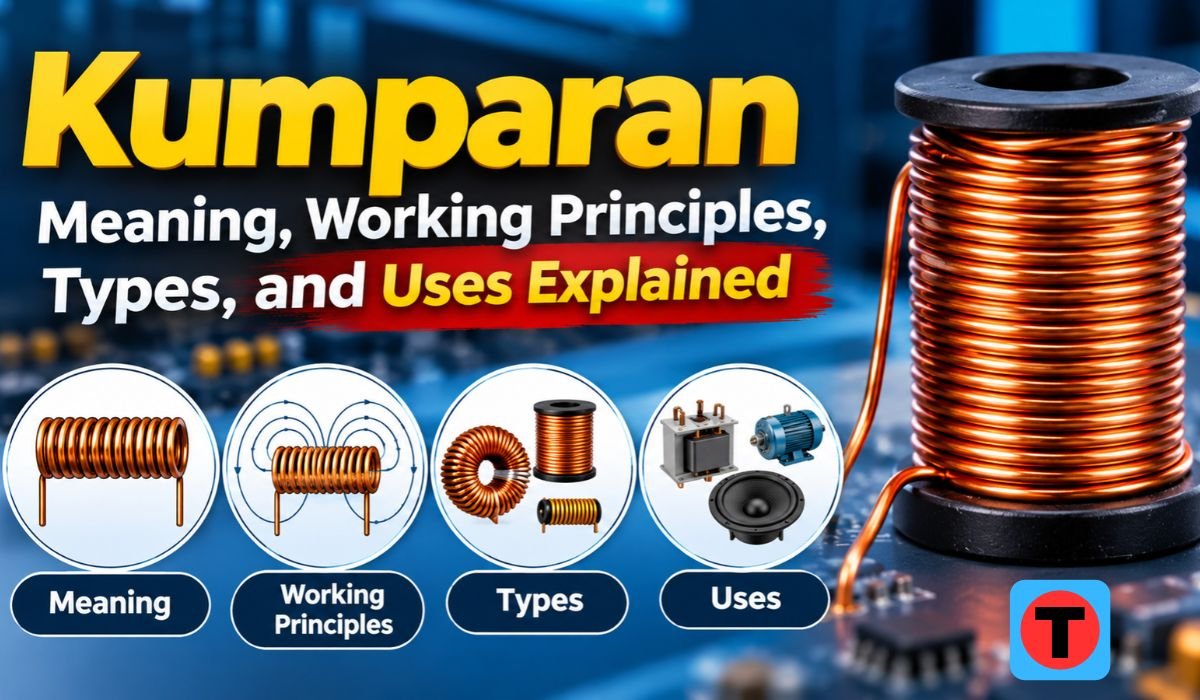
Electricity powers almost everything around us, from household appliances to industrial machines. Yet many electrical devices depend on a surprisingly simple component: a wire arranged into a series of loops. This component is known as Kumparan, an electrical coil that plays an essential role in modern technology.
Kumparan helps electrical equipment produce magnetic fields, transfer energy, and control electrical current. It is commonly found in transformers, electric motors, generators, electronic circuits, and measuring instruments. Although its construction may appear simple, its operation involves important principles of electricity and magnetism.
Understanding Kumparan is useful for students, electronics enthusiasts, technicians, and anyone curious about how electrical devices work. This guide explains its meaning, working principles, construction, different types, advantages, limitations, and practical applications in clear, everyday language.
What Is Kumparan?
Kumparan is an Indonesian term that generally means a coil or winding. In electrical engineering, Kumparan Listrik refers to conductive wire wound into multiple turns to perform an electrical or electromagnetic function.
Most electrical coils are made from copper or aluminum wire. These materials conduct electricity effectively and can be shaped into different winding arrangements. The wire usually has an insulating coating that prevents unwanted electrical contact between adjacent turns.
When electric current flows through a coil, it creates a magnetic field. Depending on its design, the coil may also store magnetic energy, produce mechanical movement, or transfer energy between circuits.
A coil is not necessarily a complete electrical device. Instead, it often forms an important part of larger equipment, including transformers, motors, relays, and inductors.
Kumparan Quick Information
| Feature | Information |
|---|---|
| Name | Kumparan |
| English Meaning | Electrical Coil or Winding |
| Indonesian Term | Kumparan Listrik |
| Engineering Field | Electrical and Electronic Engineering |
| Main Function | Producing Magnetic Fields and Supporting Electromagnetic Operations |
| Common Conductors | Copper and Aluminum |
| Basic Structure | Insulated Conductive Wire Arranged Into Turns |
| Core Materials | Air, Iron, Ferrite, or Other Magnetic Materials |
| Operating Principle | Electromagnetism |
| Related Scientific Principle | Electromagnetic Induction |
| Important Property | Inductance |
| Energy Storage | Magnetic Field |
| Common Equipment | Transformers, Motors, Generators |
| Electronic Applications | Inductors, Filters, Power Converters |
| Measuring Applications | Moving-Coil Galvanometers |
| Main Advantages | Versatility and Adaptable Design |
| Common Limitations | Heating, Resistance Losses, Insulation Damage |
| Performance Factors | Wire Size, Turns, Core Material, Frequency |
| Maintenance Needs | Temperature Control and Insulation Protection |
| Modern Applications | Electric Vehicles, Renewable Energy, Wireless Charging |
How Does Kumparan Work?
The working principle of Kumparan begins with the relationship between electricity and magnetism. Whenever electrical current passes through a conductor, a magnetic field develops around it.
When the conductor is wound into several loops, the magnetic fields produced by individual turns combine. This arrangement can create a stronger and more concentrated magnetic field than a straight wire carrying the same current.
The strength of the field depends on several factors, including the amount of current, number of turns, coil dimensions, and magnetic core.
Another important property is inductance. A coil can oppose changes in electrical current because changing current produces changing magnetic flux, which induces a voltage opposing that change.
This behavior makes electrical coils useful in circuits that require energy storage, current smoothing, voltage conversion, or electromagnetic movement.
Main Components of Kumparan
Although electrical coils vary in size and purpose, their construction usually involves several essential elements.
The most important component is the conductive wire. Copper is widely preferred because it offers excellent electrical conductivity and is relatively easy to shape. Aluminum is also used, particularly where weight and cost are important considerations.
Insulation protects the wire and prevents unwanted contact between turns. Without proper insulation, electrical short circuits may occur.
Some coils contain magnetic cores made from iron or ferrite. These materials help guide magnetic flux and can increase inductance.
Other designs use air cores, especially when avoiding certain magnetic-core losses is important.
The winding arrangement, terminals, mechanical support, and cooling method also influence how safely and efficiently a coil operates.
Different Types of Kumparan
Electrical coils are available in several forms, each designed for particular operating conditions.
An Air-Core Kumparan operates without a ferromagnetic core. It is commonly used in radio-frequency circuits and applications where magnetic saturation must be avoided.
An Iron-Core Kumparan uses a magnetic core to concentrate magnetic flux. Such arrangements are useful in transformers, electromagnets, and some low-frequency electrical equipment.
A Ferrite-Core Kumparan uses ferrite materials that are particularly valuable in many high-frequency electronic applications.
Transformer windings transfer electrical energy between circuits through electromagnetic induction. Motor windings help generate the magnetic forces required for rotation.
Inductor coils are designed to provide inductance and store energy temporarily in a magnetic field. Their construction depends on the current, frequency, and electrical performance required.
Understanding Electromagnetic Induction in Kumparan
Electromagnetic induction is one of the most important scientific principles behind electrical coils.
It occurs when changing magnetic flux through a circuit produces an electromotive force, commonly described as induced voltage.
Michael Faraday established the fundamental relationship between changing magnetic flux and induced voltage. Faraday’s law explains why coils are so useful in transformers and generators.
For example, when alternating current passes through a transformer’s primary winding, it produces changing magnetic flux in the core. This changing flux induces voltage in the secondary winding.
The number of turns influences the induced voltage. However, the final performance also depends on magnetic coupling, frequency, core properties, and electrical losses.
Electromagnetic induction also supports technologies such as wireless charging, electrical generators, and certain sensing systems.
How Kumparan Works in Electrical Transformers
Transformers are among the most familiar applications of Kumparan.
A conventional transformer contains primary and secondary windings that are magnetically coupled, usually through a shared magnetic core.
When alternating current flows through the primary winding, it creates changing magnetic flux. This flux induces voltage in the secondary winding, allowing electrical energy to transfer between circuits.
A step-up transformer increases voltage, while a step-down transformer reduces it. The voltage relationship depends primarily on the ratio of winding turns in an ideal transformer.
Transformers are essential in electricity distribution, electronic power supplies, industrial equipment, and many household devices.
Their efficiency depends on winding resistance, magnetic-core losses, insulation quality, and cooling. Proper design also helps prevent overheating and electrical failure.
The Role of Kumparan in Electric Motors and Generators
Kumparan plays an important role in converting energy between electrical and mechanical forms.
In electric motors, current flowing through windings interacts with magnetic fields to produce torque. This rotational force allows motors to operate fans, pumps, washing machines, and industrial machinery.
The exact arrangement depends on the motor design. Some motors use stationary stator windings, while others also contain rotor windings.
Generators operate through a related electromagnetic principle. Mechanical movement changes magnetic flux through windings, producing electrical voltage.
This process is used in power stations, wind turbines, and many other electricity-generating systems.
Although motors and generators perform different energy conversions, both rely heavily on magnetic fields, conductive windings, and carefully designed electrical systems.
Kumparan in Electrical Measuring Instruments
Electrical coils are also important in sensitive measuring instruments.
One traditional example is the moving-coil galvanometer, which detects small electrical currents through the movement of a coil inside a magnetic field.
When current passes through the coil, electromagnetic torque causes it to rotate. The resulting movement can indicate the current flowing through the instrument.
Some sensitive galvanometers use a small mirror attached to the moving system. A beam of light reflects from the mirror onto a distant scale.
As the mirror rotates, the reflected light spot moves across the scale. This optical arrangement makes very small movements easier to observe without adding a heavy mechanical pointer.
The technique illustrates how Kumparan can support precise electrical measurement, although modern digital instruments commonly use different sensing methods.
Common Uses of Kumparan in Everyday Life
Electrical coils are found in far more devices than most people realize.
Household appliances use motor windings to produce movement. Refrigerators, fans, washing machines, and air-conditioning equipment commonly depend on electric motors.
Electronic devices use inductors and transformers to manage electrical energy. Power supplies often contain coils that help convert voltage or smooth changing currents.
Automotive systems use coils in ignition equipment, relays, electric motors, and various electromagnetic components.
Communication equipment may contain coils in radio-frequency filters, tuning circuits, and signal-processing systems.
Industrial machinery relies on electromagnetic actuators, motors, and transformers for automated operations.
These applications demonstrate how a relatively simple winding arrangement can perform many different functions depending on its electrical design.
Advantages of Using Kumparan
One major advantage of Kumparan is its versatility. Electrical coils can be designed for applications ranging from tiny electronic circuits to large industrial equipment.
Their construction is adaptable. Engineers can adjust the number of turns, wire thickness, winding shape, and core material to achieve specific performance requirements.
Coils also support efficient electromagnetic energy conversion when properly designed.
Another advantage is reliability. A well-manufactured winding with suitable insulation and temperature control can operate for many years.
Electrical coils can also provide temporary magnetic energy storage without requiring moving mechanical parts.
However, their performance depends on appropriate design and operating conditions. Not every coil is suitable for every electrical application.
Limitations and Challenges of Electrical Coils
Despite their usefulness, electrical coils have several limitations.
Electrical resistance causes energy loss when current flows through the wire. This loss produces heat, which can reduce efficiency and damage insulation if temperatures become excessive.
Magnetic-core saturation is another concern. Certain core materials cannot continue increasing magnetic flux proportionally when subjected to sufficiently strong magnetic fields.
Coils may also experience losses associated with alternating current, including eddy currents and magnetic hysteresis in suitable core materials.
Physical size and weight can become important in high-power equipment.
Insulation deterioration, vibration, moisture, and electrical overloads may also shorten operating life.
Understanding these limitations helps engineers select appropriate materials, cooling methods, and protective systems.
How to Identify and Maintain a Damaged Kumparan
A damaged electrical coil can affect equipment performance and create safety risks.
Common warning signs include unusual heating, burning smells, discoloration, unexpected noise, and reduced electrical performance.
Damage may result from excessive current, poor ventilation, moisture, mechanical vibration, or deteriorating insulation.
A multimeter can sometimes identify an open winding through resistance or continuity measurements. However, simple measurements cannot reliably detect every shorted turn or insulation defect.
Maintenance should focus on preventing overheating, protecting insulation, and ensuring suitable operating conditions.
Electrical equipment should be disconnected and made safe before inspection. High-voltage equipment, capacitors, and mains-powered systems may remain dangerous even after being switched off.
Complex testing and repairs should be performed by qualified technicians.
Kumparan vs. Other Electrical Components
Kumparan is closely related to several electrical components, but the terms are not always interchangeable.
An inductor is a component designed to provide inductance. Many inductors contain coils, although their exact construction varies.
A transformer generally contains two or more magnetically coupled windings. An individual Kumparan may form part of a transformer, but a single coil is not automatically a complete transformer.
An electromagnet uses electrical current to generate a magnetic field. A coil can function as an electromagnet, particularly when combined with a suitable magnetic core.
A solenoid may describe a cylindrical coil or an actuator that uses electromagnetic force to produce mechanical movement.
Understanding these differences helps readers recognize the specific purpose of each component.
Factors That Affect Kumparan Performance
Several design choices determine how effectively an electrical coil operates.
The number of turns influences magnetic field strength, inductance, and induced voltage under appropriate conditions.
Wire thickness affects resistance and current-handling capability. Thicker conductors generally have lower resistance for the same material and length.
Core material influences magnetic behavior, including permeability, losses, and saturation.
Operating frequency also matters. At higher frequencies, conductor effects and magnetic losses may become increasingly important.
Temperature, winding geometry, insulation, and cooling arrangements further influence reliability.
For this reason, coil design involves balancing electrical performance, physical dimensions, efficiency, cost, and safety.
The Future of Kumparan in Modern Technology
Electrical coils remain important as technology continues to develop in 2026.
Electric vehicles depend on motor windings, inductors, transformers, and other electromagnetic components for propulsion and power conversion.
Renewable energy systems use coils in generators, converters, and electricity distribution equipment.
Wireless charging technologies rely on magnetic coupling between transmitting and receiving coils to transfer energy without direct electrical contacts.
Engineers are also improving magnetic materials, insulation systems, and winding techniques to reduce losses and improve power density.
Although the basic principles of Kumparan have been understood for generations, modern materials and manufacturing methods continue to expand its applications.
FAQs About Kumparan
What Is Kumparan in Simple Words?
Kumparan is an electrical coil made from conductive wire arranged into turns. It is used to create magnetic fields, provide inductance, or support electromagnetic energy conversion. Electrical coils are essential components in motors, transformers, generators, and electronic equipment.
What Is the Main Function of Kumparan?
The main function depends on its application. Some coils produce magnetic fields, while others transfer energy, store magnetic energy, or help control changes in electrical current. Their versatility makes them useful across many electrical systems.
How Does Kumparan Produce a Magnetic Field?
When electric current passes through conductive wire, it creates a magnetic field around the conductor. Winding the wire into loops allows the magnetic fields from individual turns to combine. The resulting field depends on current, winding geometry, and core material.
What Materials Are Used to Make Kumparan?
Copper and aluminum are commonly used as conductors because they offer good electrical conductivity. The wire usually includes insulation to prevent short circuits. Depending on the application, a coil may also contain an iron core, ferrite core, or nonmagnetic support structure.
What Is the Difference Between Kumparan and a Transformer?
Kumparan refers to a coil or winding, while a transformer is an electrical device that uses magnetically coupled windings to transfer energy between circuits. A transformer usually contains primary and secondary windings, making coils essential parts of its construction.
Can Kumparan Work Without an Iron Core?
Yes. Air-core coils operate without iron or another ferromagnetic core. They are useful in certain high-frequency circuits and applications where avoiding magnetic saturation is important. Their inductance and magnetic behavior differ from those of magnetic-core coils.
Why Does Kumparan Become Hot?
Electrical coils become hot mainly because their conductors have resistance. When current flows, some electrical energy converts into heat. Alternating-current effects and magnetic-core losses may contribute additional heating. Excessive temperatures can damage insulation and reduce equipment reliability.
Why Is Kumparan Important in Modern Technology?
Kumparan supports many essential electrical functions, including electromagnetic energy conversion, voltage transformation, magnetic actuation, and current control. Without electrical coils, numerous motors, generators, transformers, and electronic power systems would not operate in their familiar forms.
Conclusion: Understanding the Importance of Kumparan
Kumparan may appear to be a simple arrangement of wire, but it performs some of the most important functions in electrical engineering. Its ability to produce magnetic fields, support electromagnetic induction, and provide inductance makes it essential in countless technologies.
From household appliances and industrial motors to renewable energy systems and electric vehicles, electrical coils help convert, transfer, and control energy.
Understanding their construction, working principles, applications, and limitations provides a valuable foundation for learning about modern electrical systems.
As technology continues to advance, Kumparan will remain an important component in the development of efficient, reliable, and innovative electrical equipment.
Learn more and explore exciting content on: How Customised Design Choices Shape the Beauty of Modern Living Rooms

















Leave a Reply