
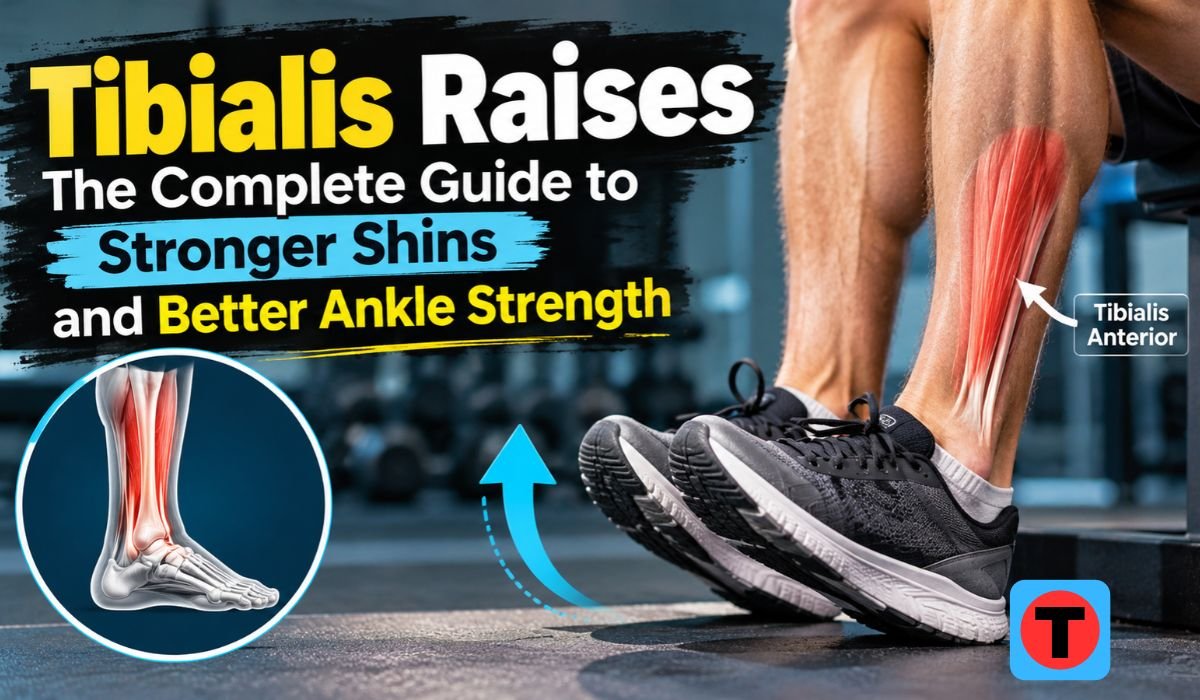
When people think about building stronger legs, they usually focus on squats, lunges, and calf raises. However, one important muscle often gets overlooked: the tibialis anterior, located along the front of the shin. This muscle helps lift your feet, control ankle movement, and support everyday activities such as walking, climbing stairs, and running.
Tibialis Raises are a simple exercise designed to strengthen this often-neglected muscle. They require little equipment, can be performed at home, and fit easily into most fitness routines. Whether you’re a beginner, runner, athlete, or someone interested in better lower-leg strength, this exercise can be a useful addition to your workouts.
Understanding proper technique is important because small changes in foot placement and movement can affect how challenging the exercise feels. This guide explains Tibialis Raises Benefits, correct form, exercise variations, training frequency, and practical ways to develop stronger shins safely.
What Are Tibialis Raises?
Tibialis Raises are lower-leg strengthening exercises that primarily target the tibialis anterior muscle. The movement involves lifting your toes and the front of your feet toward your shins while keeping your heels on the ground. This action is called ankle dorsiflexion, an essential movement used throughout daily life.
Unlike calf raises, which involve lifting your heels, Tibialis Raises strengthen muscles responsible for pulling the foot upward. These muscles help prevent your toes from dragging during walking and contribute to controlled foot movement.
One reason this exercise has become popular in fitness routines is its simplicity. Beginners can perform seated variations, while experienced exercisers can increase resistance using bands, specialized machines, or more challenging body positions.
Although Tibialis Raises are commonly associated with runners and athletes, they can also benefit people who want to strengthen their lower legs as part of a balanced fitness program.
Quick Information About Tibialis Raises
| Exercise Information | Details |
|---|---|
| Exercise Name | Tibialis Raises |
| Exercise Type | Strength Training |
| Primary Muscle | Tibialis Anterior |
| Muscle Location | Front Of The Lower Leg |
| Main Movement | Ankle Dorsiflexion |
| Difficulty Level | Beginner To Advanced |
| Equipment Required | None For Basic Variations |
| Common Equipment | Wall, Chair, Resistance Band |
| Starting Position | Seated Or Standing |
| Main Purpose | Shin Muscle Strengthening |
| Beginner Sets | Two Sets |
| Beginner Repetitions | Ten To Fifteen |
| Suggested Frequency | Two To Three Sessions Weekly |
| Advanced Training | Progressive Resistance |
| Home Workout Suitable | Yes |
| Main Movement Benefit | Improved Dorsiflexor Strength |
| Common Users | Beginners, Runners, Athletes |
| Exercise Progression | Bodyweight To Added Resistance |
| Important Safety Consideration | Avoid Exercising Through Significant Pain |
| Recovery Requirement | Depends On Exercise Intensity |
Understanding The Tibialis Anterior Muscle
The tibialis anterior is a long muscle running along the front and outer portion of the shinbone. It begins near the upper tibia and connects through a tendon to bones on the inner side of the foot.
Its primary responsibility is dorsiflexion, which means bringing the top of the foot closer to the shin. It also assists with foot inversion, a movement that turns the sole inward.
During walking, this muscle helps lift the toes as the leg swings forward. After the heel touches the ground, it helps control how the forefoot lowers toward the floor.
The tibialis anterior works alongside the calf muscles, smaller foot muscles, and other structures around the ankle. Strengthening it can improve its ability to handle resistance, but healthy movement depends on the entire lower body working together.
Major Benefits Of Tibialis Raises
The most direct benefit of Tibialis Raises is improved strength and muscular endurance in the front of the lower leg. As the tibialis anterior repeatedly works against resistance, it can gradually adapt and become better at performing the movement.
Another benefit is improved control of ankle dorsiflexion. Stronger muscles can help manage foot positioning during walking and other activities requiring repeated ankle movement.
Tibialis Raises also complement calf strengthening. While calf raises develop muscles behind the lower leg, Tibialis Raises train muscles on the opposite side, creating a more complete lower-leg workout.
For runners and physically active individuals, this additional strength may improve local muscular conditioning. However, research does not establish that Tibialis Raises alone prevent ankle injuries, eliminate shin splints, or directly improve running speed.
Their greatest value comes from being part of a balanced exercise routine.
Tibialis Raises Vs. Calf Raises
Although Tibialis Raises and calf raises both strengthen the lower legs, they target different muscles and movements.
Tibialis Raises primarily work the tibialis anterior through dorsiflexion. Calf raises mainly target the gastrocnemius and soleus muscles through plantarflexion, which points the foot downward.
Both movements play important roles in walking and running. The calf muscles help produce force during push-off, while the tibialis anterior helps lift and control the foot.
Rather than choosing one exercise over the other, including both can provide more complete lower-leg strengthening.
How To Do Tibialis Raises Correctly
Wall-supported Tibialis Raises are among the easiest variations to learn. Begin by standing with your back resting against a stable wall. Position your feet approximately hip-width apart and slightly forward from the wall.
Keep your heels planted firmly on the floor. Slowly lift your toes and forefoot toward your shins while maintaining a comfortable ankle position.
Pause briefly when you reach the highest controlled position. Then lower your feet gradually without allowing them to drop suddenly.
Your movement should come mainly from your ankles rather than swinging your legs or rocking your body. Breathe naturally and maintain a comfortable posture.
If the movement feels too difficult, bring your feet closer to the wall. Moving them farther forward generally increases the challenge.
Beginners can start with two sets of ten to fifteen controlled repetitions.
Best Tibialis Raise Variations For Beginners
Seated Tibialis Raises are an excellent starting option because they require minimal balance. Sit upright in a stable chair with your feet flat on the floor. Keep your heels down while lifting your toes, then slowly lower them.
Standing toe raises offer another simple variation. Stand near a sturdy support, gently shift your weight toward your heels, and raise the front of your feet.
Wall-supported Tibialis Raises provide a slightly different challenge because your body position changes the resistance placed on the ankle muscles.
Resistance band dorsiflexion is also useful. Sit with your leg supported and attach a resistance band securely in front of your foot. Pull your toes toward your shin against the band’s resistance.
Each variation allows beginners to practice controlled ankle movement before progressing to more demanding exercises.
Advanced Tibialis Raises For Greater Strength
Once basic Tibialis Raises become comfortable, increasing resistance can help maintain progress.
With wall-supported raises, moving your feet farther away from the wall generally increases the effort required. However, your heels should remain planted and your position stable.
Resistance bands offer another progression method. Choosing a stronger band or increasing tension makes dorsiflexion more challenging.
Specialized tibialis raise machines allow users to train against adjustable resistance. These machines are commonly found in some strength-training facilities.
Weighted variations may also be appropriate for experienced trainees, provided the equipment is secure and the movement remains controlled.
Progress gradually instead of adding excessive resistance. Good technique and consistent training are more important than lifting heavy loads.
How Many Sets And Reps Should You Perform?
The ideal number of sets and repetitions depends on your fitness level, exercise difficulty, and training goals.
Beginners may start with two sets of ten to fifteen repetitions, performed at a comfortable pace. This provides an opportunity to develop coordination and become familiar with the movement.
More experienced individuals may perform two to four sets of approximately twelve to twenty repetitions. These ranges are practical starting suggestions rather than scientifically established requirements for everyone.
If your goal is strength, gradually increasing resistance while maintaining proper technique may be more useful than endlessly adding repetitions.
Monitor your progress through improved movement control, comfortable repetitions, and greater resistance tolerance.
How Often Should You Perform Tibialis Raises?
For beginners, performing Tibialis Raises two or three times weekly is a reasonable starting approach. This allows opportunities for training while providing recovery between challenging sessions.
Some people may tolerate light ankle movements more frequently, but demanding daily workouts are unnecessary.
Recovery needs depend on exercise intensity, previous training experience, and other activities such as running or jumping.
Mild muscular fatigue can occur after training. However, persistent pain, worsening soreness, or discomfort affecting normal walking suggests the exercise load may need adjustment.
Consistency over several weeks is generally more useful than performing excessive repetitions in a single session.
Tibialis Raises For Runners And Athletes
Running places repeated demands on the muscles surrounding the ankles. During each stride, the tibialis anterior helps lift the foot during the swing phase and control its movement after ground contact.
Tibialis Raises may help runners develop greater strength and endurance in this muscle, particularly if they have not previously included direct dorsiflexion exercises.
Athletes involved in basketball, football, hiking, and other activities requiring frequent foot movement may also benefit from balanced lower-leg strengthening.
However, stronger shin muscles do not automatically mean faster running, higher jumping, or fewer injuries.
Athletic performance depends on overall strength, movement technique, coordination, conditioning, and recovery. Tibialis Raises should complement these elements rather than replace them.
Can Tibialis Raises Help With Shin Splints?
Shin splints, commonly associated with medial tibial stress syndrome, involve exercise-related pain around the shin. They frequently occur in people who experience repeated loading from running or jumping.
Tibialis Raises strengthen the muscles responsible for lifting the foot, but they are not a guaranteed treatment for shin splints.
Some rehabilitation programs include progressive ankle strengthening as part of a broader approach involving activity modification, gradual loading, and recovery.
Importantly, shin pain does not always originate from the tibialis anterior. Persistent or localized pain may indicate other conditions, including bone stress injuries.
Avoid training through significant pain. If symptoms worsen, swelling develops, or pain continues during rest, seek professional medical assessment.
Common Tibialis Raise Mistakes To Avoid
One common mistake is performing repetitions too quickly. Raising the toes rapidly and allowing them to drop removes much of the controlled muscular effort.
Another mistake is lifting the heels instead of keeping them planted. This changes the movement and reduces the intended focus on ankle dorsiflexion.
Some beginners position their feet too far from the wall, creating more resistance than they can comfortably manage.
Using excessive resistance, forcing the ankle beyond a comfortable range, or performing challenging sessions without sufficient recovery can also cause problems.
The best approach is to use slow, controlled movements, select an appropriate difficulty level, and increase resistance gradually.
How To Add Tibialis Raises To Your Workout Routine
Tibialis Raises fit naturally into lower-body strength sessions, home workouts, and running-related conditioning programs.
A balanced lower-leg workout might combine Tibialis Raises with calf raises, single-leg balance exercises, and comfortable ankle mobility movements.
Beginners can perform Tibialis Raises after a short warm-up, such as easy walking or cycling. Starting with two controlled sets is often sufficient.
As strength improves, the exercise can become more challenging through additional resistance or carefully adjusted body positioning.
For people who run regularly, performing demanding shin-strengthening exercises away from particularly intense running sessions may help manage overall training fatigue.
The goal is not to make every workout difficult. Instead, build a sustainable routine that gradually improves lower-leg strength without creating unnecessary discomfort.
Final Thoughts
Tibialis Raises are a simple and accessible way to strengthen the front of the lower legs. By targeting the tibialis anterior, they develop the muscles responsible for lifting the foot and controlling ankle dorsiflexion.
Their flexibility makes them suitable for beginners, home workouts, runners, and experienced fitness enthusiasts.
However, they work best as part of a complete strengthening program that also includes calf training, balance exercises, appropriate recovery, and gradual progression.
Start with a comfortable variation, focus on proper technique, and allow your strength to improve over time. Small, consistent improvements can make Tibialis Raises a valuable addition to your long-term fitness routine.
FAQs About Tibialis Raises
What Muscles Do Tibialis Raises Work?
Tibialis Raises primarily target the tibialis anterior muscle located along the front of the shin. Other ankle dorsiflexor muscles may assist during the movement. The exercise helps strengthen the muscles responsible for lifting the foot toward the shin.
Can You Do Tibialis Raises Every Day?
Light, comfortable repetitions may be tolerated daily by some individuals. However, challenging strength-training sessions generally benefit from recovery time. Beginners can start with two or three weekly sessions and adjust according to comfort and training progress.
Are Tibialis Raises Good For Beginners?
Yes. Tibialis Raises are beginner-friendly because they can be performed without specialized equipment. Seated and wall-supported variations allow new exercisers to develop strength and movement control gradually.
Can Tibialis Raises Prevent Shin Splints?
There is insufficient evidence that Tibialis Raises alone reliably prevent shin splints. They may contribute to lower-leg conditioning, but injury risk also depends on training volume, recovery, running demands, and individual factors.
Do Tibialis Raises Improve Ankle Mobility?
Tibialis Raises strengthen the muscles that actively lift the foot and may improve control within the available ankle range. However, restricted mobility caused by joint stiffness or other limitations may require additional approaches.
How Long Does It Take To See Results?
Improvement depends on training consistency, starting strength, resistance, and recovery. Some people notice better exercise control within several weeks, while measurable strength gains may take longer. There is no fixed timeline that applies to everyone.
Can You Perform Tibialis Raises At Home?
Yes. Seated toe raises and wall-supported Tibialis Raises require no specialized gym equipment. A stable chair, wall, and suitable floor surface are enough to begin.
Should Tibialis Raises Cause Shin Pain?
Tibialis Raises may create muscular effort or mild fatigue, especially when the exercise is unfamiliar. However, sharp, persistent, or worsening shin pain is not something to ignore. Stop or modify the exercise and seek professional advice when symptoms are concerning.
Learn more and explore exciting content on: Zanus: A Complete Guide to AI Features, Benefits, and Business Solutions
















Leave a Reply