
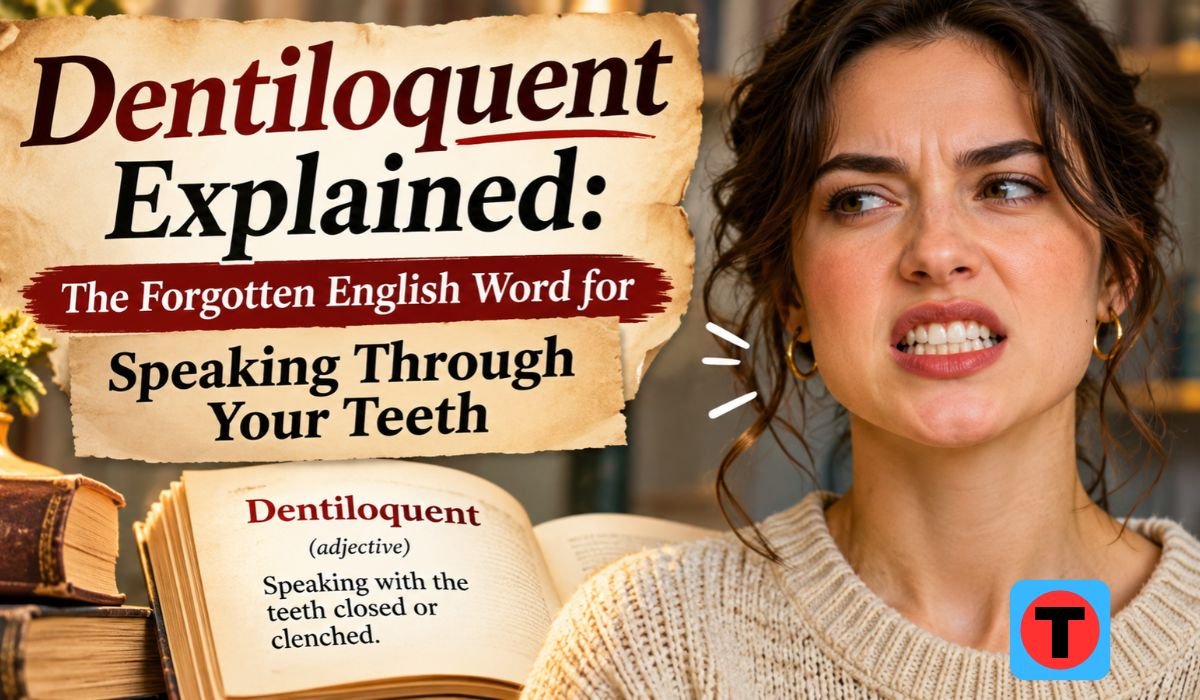
Have you ever heard someone speaking through their teeth without opening their mouth very much? Perhaps they were trying to control their frustration, concentrate on something difficult, or deliver a dramatic line. Interestingly, there is an exceptionally rare English word associated with this particular speaking style: Dentiloquent.
Although Dentiloquent is unfamiliar to most people, its meaning is surprisingly simple. Its linguistic roots connect two ordinary human activities: using our teeth and speaking. Its reported history also stretches back several centuries, offering an interesting glimpse into the development of English vocabulary. In 2026, exploring forgotten words like Dentiloquent remains a fascinating way to discover how language captures even the smallest details of human behavior.
What Is Dentiloquent?
Dentiloquent is a rare English adjective that describes speaking through one’s teeth. It refers to a manner of speaking in which the teeth remain relatively close together, often with limited jaw movement. Unlike words that describe the quality or meaning of speech, Dentiloquent focuses on how words are physically delivered. Imagine someone answering a difficult question while keeping their jaw firm and their mouth barely open. Their response might sound controlled or tense, but it could still be perfectly understandable. This situation illustrates the Dentiloquent Meaning in simple English. Importantly, the word does not automatically suggest anger, dishonesty, nervousness, or any particular personality trait.
Quick Information About Dentiloquent
| Attribute | Information |
|---|---|
| Word | Dentiloquent |
| Language | English |
| Part of Speech | Adjective |
| Primary Meaning | Speaking through one’s teeth |
| Suggested Pronunciation | den-TIL-uh-kwent |
| Number of Syllables | Four |
| Linguistic Origin | Latin-related elements |
| Root Word | Dens / Dent- |
| Root Meaning | Tooth |
| Speech-Related Root | Loqui |
| Historical Documentation | 1656 |
| Historical Dictionary | Glossographia |
| Lexicographer | Thomas Blount |
| Scholarly Research | Allen Walker Read, 1978 |
| Collins Submission Date | August 23, 2012 |
| Related Words | Dentiloquy and Dentiloquist |
| Modern Usage | Exceptionally rare |
| Medical Classification | Not a clinical diagnosis |
| Vocabulary Category | Rare English vocabulary |
| Practical Applications | Literature and language studies |
How to Pronounce Dentiloquent
The suggested Dentiloquent Pronunciation is den-TIL-uh-kwent, with four syllables and an emphasis on the second syllable. Although its spelling looks complicated, the individual sounds are relatively familiar. The beginning resembles words connected with dental health, while the ending sounds similar to eloquent. Breaking the word into smaller sounds makes it easier to pronounce and remember. However, because Dentiloquent is exceptionally uncommon, a firmly established modern pronunciation is difficult to confirm. The suggested pronunciation should therefore be considered a helpful guide rather than an official standard. Understanding the word’s construction can also make learning its pronunciation a more enjoyable experience.
Origin and Etymology of Dentiloquent
The Dentiloquent Origin becomes clearer when we examine its Latin-related linguistic elements. The first component comes from the Latin word dens, with the stem dent-, meaning tooth. This element also appears in familiar English words such as Dentist, Dental, and Denture. The second component relates to the Latin verb loqui, meaning to speak. Its influence can be seen in words such as Eloquent, Loquacious, Colloquy, and Soliloquy. Together, these elements explain the connection between teeth and speech. Studying Dentiloquent Etymology also demonstrates how understanding Latin roots can help readers recognize the meanings of unfamiliar English words without relying entirely on memorization.
The Forgotten History of Dentiloquent
The documented history of Dentiloquent reaches back to 1656, when Thomas Blount published his dictionary Glossographia. This historical reference work helped readers understand difficult and unfamiliar expressions. Linguist Allen Walker Read later discussed Dentiloquent in his 1978 scholarly paper, The Sources of Ghost Words in English. His discussion drew on Arthur G. Kennedy’s research from 1927 into unusual dictionary expressions known as Hothouse Words. This academic evidence establishes a historical record of Dentiloquent extending across several centuries. However, its inclusion in an early dictionary does not prove that it was ever widely spoken. Its preservation illustrates how dictionaries can maintain vocabulary that ordinary speakers rarely encounter.
Taylor & Francis Online
Is Dentiloquent a Real English Word?
Yes, Dentiloquent is a historically documented English word, although its modern dictionary status deserves careful explanation. Collins English Dictionary includes Dentiloquent in its New Word Suggestion section, with a submission dated August 23, 2012. The available entry indicates that its usage is being monitored. This means that its appearance on the Collins website should not be confused with acceptance as an established dictionary headword. In 2026, the most accurate way to describe Dentiloquent is as a historically recorded but exceptionally uncommon expression. Its existence in linguistic records is supported by evidence, while its popularity and frequency in ordinary conversation remain limited or uncertain.
Collins English Dictionary
What Does Dentiloquent Speech Sound Like?
Dentiloquent Speech may sound unusually controlled because the speaker maintains a relatively firm jaw while talking. Normal speech requires coordinated movements involving the tongue, lips, jaw, and other structures within the mouth. Restricting some of these movements may influence articulation and the production of certain sounds. However, speaking through one’s teeth does not necessarily make every word difficult to understand. Some individuals may remain clear and audible despite limited jaw movement. The defining characteristic is the physical manner of speaking rather than the speaker’s volume, pitch, or speed. Actors sometimes demonstrate a similar effect when delivering dialogue intended to communicate restrained tension or concentration.
Does Dentiloquent Always Indicate Anger?
Speaking through clenched teeth is often associated with anger, particularly when someone is attempting to control their frustration. However, the Dentiloquent Definition does not require any specific emotion. Someone might speak through closely positioned teeth because of discomfort, nervousness, concentration, or a deliberate acting performance. A person could even use this speaking style while feeling completely calm. Understanding this distinction is especially valuable for writers because physical behavior does not always reveal someone’s thoughts or feelings. Facial expressions, surrounding circumstances, and the content of a conversation provide additional clues. Dentiloquent describes the manner of speech, but the emotional meaning depends on the situation.
Dentiloquent vs. Similar English Words
Dentiloquent is sometimes confused with other speech-related expressions, particularly because its spelling resembles Eloquent. However, Eloquent describes someone who communicates ideas effectively, while Loquacious refers to someone who talks a great deal. Mumbling usually involves indistinct speech, whereas Muttering generally refers to quiet or unclear speech. Whispering describes another method of producing speech with reduced or absent ordinary voicing. Dentiloquent differs from all these expressions because it specifically concerns the position of the teeth during speaking. Someone could theoretically deliver an eloquent statement while speaking through their teeth. Understanding these differences helps readers select more precise vocabulary without confusing physical speech delivery with communication ability.
Dentiloquent Synonyms and Alternative Expressions
Finding an exact single-word Dentiloquent Synonym is difficult because the adjective describes a highly specific behavior. Speaking through one’s teeth is the closest straightforward alternative. Other useful expressions include talking with a tight jaw, speaking through clenched teeth, and talking with closely held teeth. However, these expressions are not always perfectly interchangeable because closely positioned teeth do not necessarily mean that the jaw is tightly clenched. For everyday conversations, ordinary expressions are generally clearer and more practical than obscure vocabulary. Dentiloquent may be more suitable when discussing forgotten English words or experimenting with descriptive language. Choosing the right expression ultimately depends on the reader and the purpose of communication.
How to Use Dentiloquent in a Sentence
Understanding Dentiloquent Examples can help readers recognize how the adjective might function in modern writing. A novelist could write, “His dentiloquent reply came through barely parted teeth.” Another example might be, “The actor adopted a dentiloquent delivery to express restrained frustration.” In a different situation, a writer could describe someone by saying, “Her dentiloquent warning was quiet but perfectly understandable.” These original examples illustrate how the word can describe a response, voice, warning, or speaking style. Since most readers are unlikely to recognize the term immediately, including a descriptive clue alongside it is helpful. These sentences demonstrate possible contemporary usage rather than documented historical examples.
Dentiloquent, Dentiloquy, and Dentiloquist
Dentiloquent belongs to a small group of rare expressions connected with speaking through the teeth. The related noun Dentiloquy refers to the act or habit of speaking in this manner, while Dentiloquist appears in rare vocabulary collections as a term for someone who does so. Their main difference concerns grammatical function. Dentiloquent describes a characteristic, Dentiloquy names the behavior, and Dentiloquist identifies the person associated with it. These distinctions illustrate how English can use related linguistic elements to describe an action, a quality, and an individual. Nevertheless, these expressions should be treated as obscure vocabulary rather than familiar modern terminology, particularly because their documented usage varies.
Practical Uses of Dentiloquent in Modern Life
Despite its rarity, Dentiloquent has potential value in Creative Writing, Literature, Acting, and Language Education. Writers can explore the word when developing distinctive character descriptions, while actors may find its underlying concept useful when experimenting with physical approaches to dialogue. Students can examine its Latin-related elements to understand how English vocabulary develops. Historical researchers may also find Dentiloquent interesting because it demonstrates the survival of obscure words through reference works. However, the term is unlikely to improve ordinary conversations or professional correspondence if readers need an additional explanation. Its greatest practical value lies in linguistic exploration and carefully chosen descriptive writing rather than replacing familiar expressions.
Is Dentiloquent a Medical Condition?
Dentiloquent is not a recognized medical condition, clinical diagnosis, or speech disorder. It is simply a descriptive vocabulary term associated with a particular manner of speaking. Restricted jaw movement can occur for many reasons, including personal habits, deliberate performances, dental discomfort, or underlying health problems. Nevertheless, occasionally speaking through one’s teeth does not establish that someone has a medical condition. Dentiloquent cannot explain the cause of a person’s speech pattern or determine whether treatment is necessary. Individuals experiencing persistent difficulty opening their mouths, moving their jaws, or speaking clearly may benefit from an appropriate professional assessment. Keeping descriptive vocabulary separate from medical terminology helps prevent unnecessary confusion.
Why Is Dentiloquent So Rare?
One possible reason Dentiloquent remains uncommon is that English already offers straightforward expressions describing the same behavior. Most people understand what speaking through one’s teeth means without needing an unfamiliar adjective. Historical language research also raises an interesting possibility: some learned expressions may have survived primarily because dictionary compilers preserved them, rather than because speakers regularly used them. Researchers have described such expressions using the concept of Hothouse Words, some of which may overlap with Ghost Words. However, there is insufficient evidence to definitively classify every such expression as a Ghost Word. Dentiloquent demonstrates why historical documentation and actual language usage must be considered separately.
Common Mistakes When Using Dentiloquent
A common misunderstanding is assuming that Dentiloquent automatically describes an angry or aggressive person. Another mistake is confusing it with Eloquent, Mumbling, or Whispering simply because these terms relate to speech. Writers should also avoid presenting Dentiloquent as a recognized medical diagnosis, a popular modern expression, or a newly invented internet term. Its suggested pronunciation should not be presented as an independently established standard. More importantly, the word should not be used merely to make writing sound sophisticated. Dentiloquent offers a valuable lesson about English vocabulary: knowing an unusual word is helpful, but understanding when to use it is equally important for effective communication.
Final Thoughts
Dentiloquent is a fascinating example of how English preserves exceptionally specific descriptions of human behavior. With historical documentation reaching back to 1656, its meaning, Latin-related origins, and unusual dictionary status make it an interesting subject for language enthusiasts.
Although Dentiloquent remains exceptionally rare in 2026, exploring its history provides valuable insights into vocabulary development and the relationship between language and communication. Its greatest appeal is not its complexity but its ability to describe a recognizable speaking style through a single adjective.
Ultimately, discovering forgotten English words encourages us to appreciate the richness of language while remembering that clear, meaningful communication should always come first.
FAQs About Dentiloquent
What Does Dentiloquent Mean?
Dentiloquent describes speaking through one’s teeth or talking while keeping the teeth relatively close together. It refers to physical speech delivery rather than the speaker’s emotions or communication skills.
Is Dentiloquent a Real Word?
Yes. Historical linguistic research identifies Dentiloquent in Thomas Blount’s Glossographia, published in 1656. However, it remains exceptionally uncommon in modern English.
How Do You Pronounce Dentiloquent?
The suggested pronunciation is den-TIL-uh-kwent. Because the word is extremely rare, this pronunciation should be treated as a reasonable guide rather than a confirmed modern standard.
What Is the Origin of Dentiloquent?
Dentiloquent contains Latin-related elements connected with dens, meaning tooth, and loqui, meaning to speak. These linguistic components explain its association with speaking through the teeth.
What Is a Synonym for Dentiloquent?
Speaking through one’s teeth is the closest familiar alternative. Speaking through clenched teeth or talking with a tight jaw may also be appropriate, depending on the circumstances.
Does Dentiloquent Mean Speaking Angrily?
Not necessarily. Although anger may cause someone to tighten their jaw, Dentiloquent describes a physical speaking style rather than a particular emotional state.
Is Dentiloquent a Speech Disorder?
No. Dentiloquent is a descriptive English vocabulary term, not a recognized speech disorder or medical diagnosis.
Can Dentiloquent Be Used in Everyday English?
Dentiloquent can be used in descriptive writing and conversation, but most people are unfamiliar with it. A straightforward expression such as speaking through one’s teeth is generally easier to understand.




Leave a Reply