
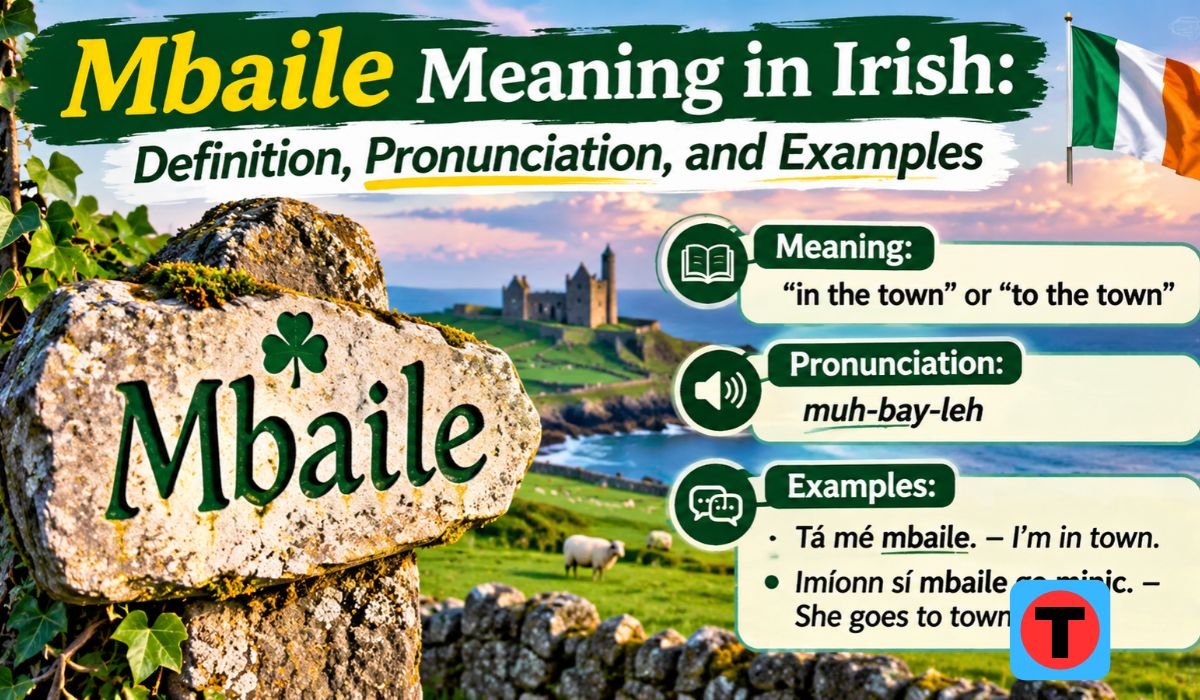
Irish is a beautiful language with a rich history, but some of its spelling rules can surprise beginners. One word that often causes confusion is Mbaile. At first glance, the combination of “m” and “b” may look unusual. However, there’s a simple grammatical reason behind it.
Understanding Mbaile Meaning in Irish starts with the word baile, which can refer to a home, town, or settlement. The additional “m” appears because of a traditional Irish grammar rule known as eclipsis.
You’ll encounter this word in everyday conversations, traditional expressions, and familiar Irish place names. Whether you’re learning Irish for the first time or exploring your family heritage, understanding Mbaile can help you recognize how the language works.
This guide explains its meaning, pronunciation, origins, grammar, and practical examples in clear, everyday language.
What Does Mbaile Mean in Irish?
Mbaile is a grammatical form of the Irish word baile, which commonly means “home,” “town,” or “settlement.” Its exact English translation depends on how it appears in a sentence.
The word itself doesn’t have a completely separate meaning. Instead, Irish grammar changes the beginning of baile by adding an “m” before the original “b.”
For example, the phrase i mbaile can refer to being in a town, while other expressions involving baile describe someone’s home.
This distinction matters because Irish uses grammatical changes to connect words within sentences. Learning the original form makes unfamiliar spellings easier to recognize.
Quick Information About Mbaile
Language
Irish (Gaeilge)
Original Word
Baile
Modified Form
Mbaile
English Meaning
Home, Town, Settlement
Word Type
Noun Form
Grammatical Gender
Masculine
Grammar Process
Eclipsis
Irish Grammar Term
Urú
Initial Mutation
B → MB
First Sound
M
Plural Of Baile
Bailte
Common Preposition
I (In)
Example
I Mbaile
Lenited Form
Bhaile
Standard Home Phrase
Sa Bhaile
Dialect Variation
Sa Mbaile
Place-Name Example
Baile Átha Cliath
Learning Resource
Teanglann.ie
Understanding the Irish Word Baile
To understand Mbaile properly, it helps to begin with baile. This is the original word you’ll usually find in an Irish dictionary.
Unlike English, where “home” and “town” normally describe different things, Irish uses baile in several related ways. It can describe someone’s home, a town, or a community where people live.
For example, baile beag means a small town or village, while baile mór refers to a large town. The plural form, bailte, describes multiple towns or settlements.
The word also appears in expressions connected to everyday life. This flexibility explains why context is essential when translating Irish accurately.
Rather than memorizing one English definition, it’s better to understand the general idea of a home or inhabited place.
Why Does Baile Change to Mbaile?
The change from baile to mbaile happens because Irish uses a grammatical feature called an initial mutation.
An initial mutation changes the beginning of a word depending on the words or grammatical structures surrounding it.
When a word beginning with “b” undergoes eclipsis, an “m” appears before it. Consequently, baile becomes mbaile.
The original letter remains visible, but the new consonant determines the initial pronunciation.
One common trigger is the Irish preposition i, meaning “in.” When followed by a suitable noun beginning with b, it causes eclipsis.
This rule isn’t unique to baile. It applies to many Irish words, making it an important pattern for anyone studying the language.
What Is Eclipsis (Urú) in Irish Grammar?
Eclipsis, called urú in Irish, is one of the language’s most important grammatical features. It changes certain initial consonants without changing the underlying identity of the word.
For example, bosca, meaning “box,” becomes mbosca after the preposition i. Similarly, cat can become gcat, while peann can become bpeann in grammatical environments requiring eclipsis.
The added consonant effectively covers the original sound.
Eclipsis also occurs after certain possessive words, numbers, and combinations of prepositions and articles. However, not every preposition causes the same mutation.
Understanding this distinction helps learners recognize why Irish words sometimes appear differently in writing.
Once you become familiar with eclipsis, many seemingly complicated Irish spellings begin to make sense.
Mbaile vs. Baile vs. Bhaile: What’s the Difference?
The words mbaile, baile, and bhaile may look like separate vocabulary items, but they’re different grammatical forms of the same noun.
Baile is the original form. It appears when no initial mutation is required, as in baile beag.
Bhaile is the lenited form, created through another Irish grammatical process called séimhiú. This mutation adds an “h” after the initial b and changes its pronunciation.
Mbaile is the eclipsed form, created when grammar requires an m before the b.
Consider the expressions ag baile, ó bhaile, and i mbaile. Each uses the same underlying noun, but the surrounding grammar determines its spelling.
Recognizing these differences is more useful than treating every variation as a completely new word.
How to Pronounce Mbaile Correctly
Mbaile pronunciation becomes easier once you understand how eclipsis affects sounds.
Although the word begins with the letters “mb,” you don’t pronounce both consonants separately. Instead, the initial sound is “m,” while the original b remains in the spelling.
An approximate English pronunciation is “MAL-yuh,” although this doesn’t perfectly represent every Irish sound or regional accent.
The word baile begins with a b sound, while mbaile begins with m. The lenited form bhaile can begin with a sound resembling English v or w, depending on the dialect.
Irish pronunciation also differs across regions, so listening to fluent speakers is particularly helpful.
Teanglann.ie offers pronunciation recordings from different Irish-speaking areas, making it a useful resource for practicing authentic pronunciation.
Common Irish Phrases and Examples Using Mbaile
Learning Irish expressions is one of the easiest ways to understand how Mbaile works in everyday language. The same underlying word appears in several phrases, but its spelling changes according to the grammar.
Obair ón mbaile means “working from home.” Here, ón combines a preposition with the definite article and causes eclipsis.
Another expression, i mbaile is i gcéin, means “at home and abroad.” It shows how Irish uses initial mutations in familiar phrases.
Meanwhile, ag baile means “at home,” and ó bhaile means “from home.” The latter uses lenition rather than eclipsis.
These expressions demonstrate an important lesson: you shouldn’t translate mbaile without considering the surrounding words. The Ó Dónaill dictionary documents these patterns and provides additional examples.
teanglann.ie+1
Sa Bhaile vs. Sa Mbaile: Which Is Correct?
Both sa bhaile and sa mbaile can appear in Irish, but their usage depends on the grammatical standard and regional dialect.
In standard written Irish, sa bhaile is the usual expression meaning “at home.” The word sa combines i and the definite article an, producing a construction that generally requires lenition before suitable consonants.
However, some regional varieties, particularly Connacht Irish, use eclipsis in comparable constructions. This explains the form sa mbaile.
For beginners, sa bhaile is the safest standard form to learn first. Recognizing regional alternatives is still valuable because Irish speakers don’t all use identical grammatical patterns.
How Mbaile Is Used in Different Irish Dialects
Irish has three major traditional dialect areas: Connacht, Munster, and Ulster. Although speakers share the same language, pronunciation and grammatical usage can differ.
Connacht Irish is particularly associated with eclipsis in certain preposition-and-article constructions where standard Irish uses lenition.
Munster Irish has distinctive pronunciation features and regional grammatical traditions. Ulster Irish also has recognizable pronunciation and mutation patterns.
These differences developed naturally within Irish-speaking communities.
For learners, the important point is that dialect variation doesn’t automatically mean one speaker is wrong. Standard Irish provides a useful foundation, while regional speech reveals the language’s living diversity.
Listening to speakers from different regions can improve both pronunciation and comprehension.
The History and Origins of Mbaile
The history of Mbaile begins with the older Irish noun baile, which has long been associated with homes, inhabited places, and communities.
Historical dictionaries also record meanings connected with land divisions and settlements. This wider background helps explain why baile appears so frequently in Irish geographical names.
However, the word’s history and its grammatical mutation are two different subjects.
The additional m in mbaile doesn’t represent a separate historical root. It appears because Irish grammar requires eclipsis in particular circumstances.
Anyone researching the origins of Mbaile should therefore begin with the history of baile itself.
The Electronic Dictionary of the Irish Language is a useful resource for exploring historical Irish vocabulary and tracing older forms.
Mbaile in Irish Place Names
Irish place names provide some of the clearest examples of how baile connects language with geography.
Dublin’s Irish name is Baile Átha Cliath, traditionally translated as “town of the hurdled ford.”
When the preposition i is added, the expression becomes i mBaile Átha Cliath, meaning “in Dublin.”
Notice the capitalization. The added m remains lowercase, while the original capital B is preserved.
Other examples include Baile Átha Luain, the Irish name for Athlone, and Baile an Mhóta, the Irish name for Ballymote.
Many English place names beginning with “Bally” also developed from Irish names containing baile.
Ireland’s official place-name database, Logainm.ie, documents these geographical names and their Irish forms.
logainm.ie+1
Common Mistakes When Learning Mbaile
One common mistake is treating Mbaile as a completely independent word. Although its spelling differs from baile, the underlying noun remains the same.
Another mistake involves pronunciation. English speakers sometimes try to pronounce both the m and b separately. In the eclipsed form, the initial consonant is pronounced as m.
Learners also occasionally confuse mbaile with bhaile. These forms represent different grammatical mutations and shouldn’t be used interchangeably.
Capitalization can cause confusion as well. Ordinary expressions use lowercase mbaile, while proper names may preserve the original capital letter, as in mBaile Átha Cliath.
The easiest way to avoid these errors is to examine the words immediately preceding the noun.
Easy Ways to Remember and Use Mbaile
The simplest way to remember Mbaile is to connect it with its original form, baile.
Whenever you encounter a word beginning with mb, consider whether it might be an eclipsed form of a word beginning with b.
Next, examine the surrounding grammar. A preceding i, for example, often explains why eclipsis has occurred.
Comparing ag baile, ó bhaile, and i mbaile can also help reinforce the differences between unchanged, lenited, and eclipsed forms.
Another useful learning habit is to search for the original word in an Irish dictionary rather than searching only for its mutated spelling.
With regular reading and listening practice, these changes gradually become familiar.
Final Thoughts on Mbaile Meaning and Usage
Understanding Mbaile Meaning in Irish is about more than learning a single definition. It introduces one of the language’s most interesting grammatical features.
Mbaile comes from baile, a word connected with homes, towns, and settlements. The additional m appears through eclipsis, while other grammatical environments can produce forms such as bhaile.
These changes may seem confusing initially, but they follow recognizable patterns.
From everyday expressions to famous Irish place names, the word offers a fascinating glimpse into how Irish grammar, history, and culture connect.
Once you understand why baile becomes mbaile, you’ll be better prepared to recognize similar changes throughout the Irish language.
FAQs About Mbaile Meaning in Irish
What Does Mbaile Mean in English?
Mbaile is the eclipsed form of baile, which can mean home, town, or settlement. Its exact translation depends on the expression or sentence in which it appears.
Is Mbaile the Same as Baile?
Yes. Both forms belong to the same underlying Irish noun. Baile is the dictionary form, while mbaile appears when grammar requires eclipsis.
How Do You Pronounce Mbaile?
Mbaile begins with an m sound rather than two separate m and b sounds. Its remaining pronunciation varies somewhat across Irish dialects. Native-speaker recordings provide the most reliable guidance.
Why Does Mbaile Begin With MB?
The spelling results from eclipsis, known as urú. When a word beginning with b undergoes this mutation, an m appears before the original consonant.
What Does Sa Bhaile Mean?
Sa bhaile means “at home” in standard Irish. It’s a common expression used when discussing someone’s location or activities at home.
teanglann.ie+1
What Is the Difference Between Mbaile and Bhaile?
Mbaile is the eclipsed form of baile, while bhaile is the lenited form. Both are grammatically related, but different constructions determine which one is appropriate.
Does Mbaile Mean Home or Town?
It can be associated with either meaning because baile has several related definitions. The surrounding words determine whether the intended meaning concerns someone’s home, a town, or another inhabited place.
What Does I mBaile Átha Cliath Mean?
I mBaile Átha Cliath means “in Dublin.” The preposition i causes eclipsis, adding a lowercase m before the capital B in Dublin’s Irish name.











Leave a Reply