
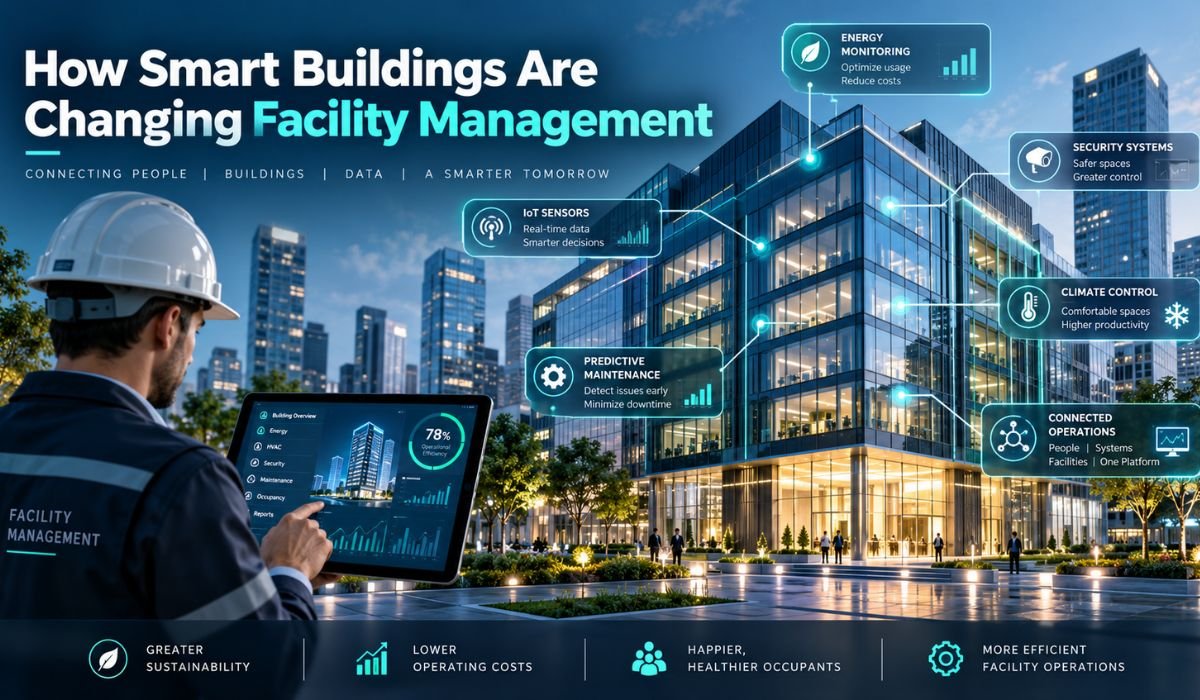
Commercial buildings have become harder to maintain. That’s the bad news. But they’ve also become far easier to monitor, and that’s where things get interesting. IoT sensors, automated cleaning rigs and centralised management platforms now do what clipboard rounds and spreadsheets never could, which is track what’s actually happening inside a building in real time, from air quality right down to contamination on wall surfaces.
Hospitals, food manufacturing plants and cleanroom environments already use this tech daily, and the results have started to reshape what “well-maintained” even means in a commercial setting. So where’s the biggest impact landing, and what does it mean for the materials these buildings are actually built from?
IoT Sensors and the End of Scheduled Guesswork
Old-school facility management runs on fixed schedules. Floors get cleaned every four hours whether they need it or not, and HVAC filters get swapped based on the calendar instead of actual airflow data. IoT sensors have torn that model apart.
Take hospitals. Air quality monitors can now pick up contamination spikes the moment they happen, which triggers ventilation adjustments before anything has a chance to spread across a ward. Temperature and humidity sensors in food manufacturing plants will flag the second cold chain conditions start to drift, so teams don’t have to rely on manual spot checks that might come too late. In cleanroom settings, particle counters wired into building management systems can shut a production line down within seconds if contamination breaches ISO thresholds.
What ties all of this together is a move towards predictive maintenance. Facility teams stop reacting to failures or blindly following rigid timetables, and instead respond to conditions as they unfold inside the building. That cuts waste and reduces downtime. In sectors like pharmaceuticals, it can also stop entire batches from being written off, which saves tens of thousands per incident.
Automated Cleaning and the Surfaces That Support It
Automated and semi-automated cleaning systems are becoming standard in any environment where hygiene standards are non-negotiable. Robotic floor scrubbers have been around for years now. The newer generation of washdown systems designed for walls and ceilings, though, is where facility managers should really be paying attention.
High-pressure washdown is routine in food processing and pharmaceutical settings. These systems blast surfaces with hot water, steam or chemical sanitisers on a set cycle. Walls need to survive that punishment without cracking, warping or degrading over time. That’s exactly why hygienic wall cladding has become the default surface material in facilities running automated or high-pressure cleaning routines. PVC cladding panels are non-porous and chemical-resistant, and because they don’t have grout lines, there are no hidden crevices where bacteria can hang around between wash cycles.
Compare that to tiled walls, which deteriorate fast under repeated high-pressure cleaning. Grout cracks. Moisture gets behind tiles. And you end up with a genuine hygiene risk buried under what still looks like a clean surface. This highlights something important about smart building technology. Once you automate cleaning, the building materials themselves need to keep up, or the whole system falls over.
Centralised Platforms Tie It All Together
No single sensor or cleaning robot changes much on its own. The software connecting everything is what actually makes a difference. Building management platforms now pull data from hundreds of IoT devices spread across a single site, then present it all in one dashboard. Facility managers can see energy use, cleaning schedules, air quality readings and equipment health without jumping between five different systems.
In a hospital, that might mean cross-referencing ventilation data with infection control metrics to spot patterns early. In a food plant, it could mean linking washdown cycle logs with microbial swab results so you can prove compliance the instant an auditor walks through the door. Over time, machine learning models baked into these platforms will start predicting which parts of a building need attention before the data even triggers a formal alert.
What This Means for the Next Generation of Commercial Spaces
Smart building tech is still in its early stages across most sectors. Hospitals and food manufacturers have pushed ahead because regulation forces them to track hygiene data in granular detail. But the same principles are starting to filter into offices, logistics centres and retail environments too.
For anyone involved in specifying or managing commercial property, the key point is simple. Building materials, cleaning systems and digital infrastructure can’t be treated as separate procurement decisions any more. The sensor mounted on the wall needs to talk to the platform running in the cloud, and the wall itself needs to survive whatever the automated cleaning system throws at it day after day. Get that integration right and you’ll spend less on repairs, reduce downtime, prove compliance faster and catch problems long before they turn into costly emergencies.










Leave a Reply