
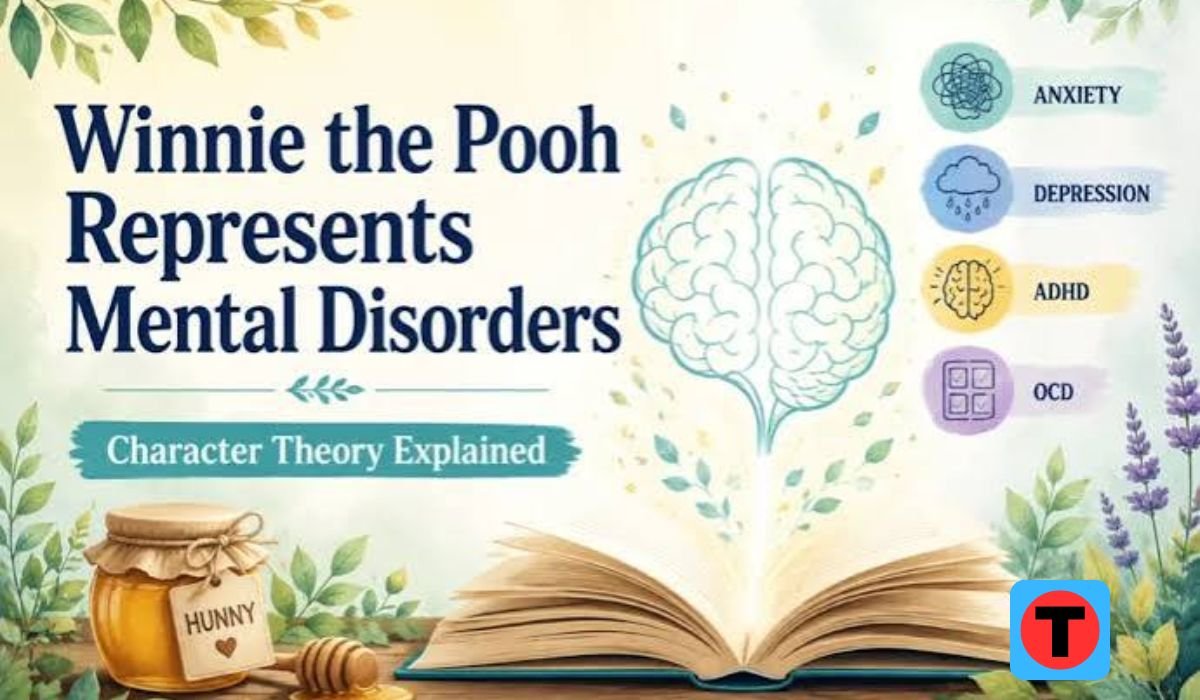
Winnie the Pooh as Mental Illness has been a beloved part of childhood for generations. From Pooh love of honey to Tigger’s endless energy and Eeyore’s gloomy personality, every character in the Hundred Acre Wood brings something special to the story. But have you ever wondered whether their personalities reflect real psychological conditions?
The Winnie the Pooh as Mental Illness theory has attracted attention because it connects familiar fictional characters with mental health conditions such as ADHD, anxiety, depression, and obsessive-compulsive disorder. These comparisons offer an interesting way to explore human behavior, emotions, and personality differences.
However, there is an important distinction between recognizing certain traits and diagnosing a mental health condition. Winnie the Pooh characters were created for storytelling, not clinical assessment. Their supposed diagnoses are interpretations rather than established medical facts.
Understanding these differences makes the theory more interesting and educational. Let’s explore what each character supposedly represents, where the idea originated, and what these stories can teach us about mental health in 2026.
Quick Bio Information About Winnie the Pooh and Mental Health
| Information | Details |
|---|---|
| Main Topic | Winnie the Pooh as Mental Illness |
| Original Creator | A. A. Milne |
| Original Book | Winnie-the-Pooh |
| First Book Publication | 1926 |
| Story Setting | Hundred Acre Wood |
| Main Character | Winnie the Pooh |
| Main Theme | Friendship, Childhood, and Imagination |
| Mental Health Theory | Psychological Interpretations of Fictional Characters |
| Academic Discussion | Pathology in the Hundred Acre Wood |
| Academic Publication | Canadian Medical Association Journal |
| Publication Year | 2000 |
| Pooh’s Suggested Condition | ADHD |
| Piglet’s Suggested Condition | Anxiety |
| Tigger’s Suggested Condition | ADHD |
| Eeyore’s Suggested Condition | Depression |
| Rabbit’s Suggested Condition | OCD |
| Christopher Robin’s Suggested Condition | Schizophrenia in Some Online Interpretations |
| Scientific Status | Speculative, Not Clinically Validated |
What Is the Winnie the Pooh Mental Illness Theory?
The Winnie the Pooh mental illness theory suggests that characters from A. A. Milne’s stories display behaviors resembling symptoms of psychological or neurodevelopmental conditions.
The idea gained attention through a satirical academic paper published in the Canadian Medical Association Journal in 2000. Titled Pathology in the Hundred Acre Wood: A Neurodevelopmental Perspective on A. A. Milne, the paper playfully examined the characters using psychiatric terminology.
Over time, online discussions transformed these humorous interpretations into character charts that associate Pooh with ADHD, Piglet with anxiety, and Eeyore with depression.
Although the theory is entertaining, it should not be treated as scientific proof. Mental health diagnoses require detailed evaluations involving symptoms, their duration, personal history, and their impact on daily functioning.
The theory is most useful when it encourages thoughtful discussions rather than encouraging people to label themselves or others.
Winnie the Pooh and Attention Difficulties
Winnie the Pooh is gentle, friendly, and famously interested in honey. He also becomes distracted, forgets things, and occasionally makes decisions without considering the consequences.
These characteristics have led some people to associate Pooh with attention-deficit/hyperactivity disorder, particularly its predominantly inattentive presentation.
For example, Pooh sometimes becomes so focused on finding honey that other responsibilities seem less important. His wandering thoughts and forgetfulness resemble behaviors that people commonly associate with attention difficulties.
However, enjoying food, becoming distracted, or forgetting something occasionally does not establish ADHD.
ADHD is a neurodevelopmental disorder involving persistent patterns of inattention and/or hyperactivity-impulsivity that interfere with functioning.
The older term ADD is sometimes used in discussions about Pooh, but ADHD is the current diagnostic term.
Pooh’s character reminds readers that occasional distraction is a normal part of life, while clinical attention difficulties involve a broader and more persistent pattern.
Piglet and Anxiety Disorder
Piglet is one of the smallest characters in the Hundred Acre Wood, but his worries often feel enormous. He becomes nervous about unfamiliar situations, imagines possible dangers, and sometimes struggles to feel confident.
Because of these behaviors, Piglet is frequently associated with anxiety disorders.
Anxiety can involve excessive worrying, restlessness, difficulty concentrating, and physical symptoms such as a racing heartbeat. However, occasional fear is a normal human response, especially when facing uncertainty.
Piglet’s personality also reveals something positive about anxiety. Despite being frightened, he often shows remarkable courage when his friends need help.
His actions demonstrate that bravery does not require the absence of fear.
Rather than viewing Piglet only through a psychological label, readers can appreciate his kindness, loyalty, and determination.
His character provides a useful starting point for discussing how people can experience fear while still participating in meaningful activities.
Tigger and Attention-Deficit/Hyperactivity Disorder
Tigger is energetic, enthusiastic, and almost always bouncing. His excitement sometimes causes him to act before thinking, interrupt others, or overlook possible consequences.
These characteristics have made him one of the most recognizable examples in the Winnie the Pooh mental disorders theory.
Tigger is commonly associated with the hyperactive and impulsive symptoms of ADHD.
In real life, ADHD can involve excessive movement, difficulty remaining seated when expected, interrupting conversations, and making impulsive decisions.
However, being cheerful, active, or adventurous does not automatically mean someone has ADHD.
Clinical ADHD requires a persistent pattern of symptoms that affects daily functioning and meets established diagnostic criteria.
Tigger also demonstrates valuable qualities, including enthusiasm, optimism, and a willingness to explore new experiences.
His personality reminds readers that energy and spontaneity can be strengths, even when certain behaviors sometimes create challenges.
Eeyore and Depression
Eeyore is known for his quiet voice, gloomy expectations, and tendency to assume that things will go wrong.
His frequent sadness has made him closely associated with depression in popular Winnie the Pooh psychological interpretations.
Depression is more complex than simply feeling unhappy. Major depressive disorder can involve persistent low mood, loss of interest in activities, changes in sleep or appetite, fatigue, difficulty concentrating, and feelings of worthlessness.
These symptoms generally need to persist for at least two weeks and cause significant distress or impairment to meet diagnostic criteria for a major depressive episode.
Eeyore’s behavior may remind readers of certain depressive symptoms, but his fictional personality cannot establish a diagnosis.
Interestingly, Eeyore’s friends continue including him in their activities even when he appears withdrawn or pessimistic.
This offers an important lesson about emotional support. People experiencing difficult emotions often benefit from patience, companionship, and understanding rather than pressure to become cheerful immediately.
Rabbit and Obsessive-Compulsive Disorder
Rabbit enjoys organization, predictable routines, and keeping his surroundings under control. He becomes frustrated when unexpected events interrupt his carefully arranged plans.
Because of these traits, Rabbit is frequently associated with obsessive-compulsive disorder, commonly called OCD.
However, this comparison requires careful explanation.
OCD involves obsessions, which are unwanted and intrusive thoughts, urges, or images, and/or compulsions, which are repetitive behaviors or mental acts often performed to reduce distress.
Someone with OCD may experience repeated fears about contamination, harm, or uncertainty, along with compulsive checking, washing, or other rituals.
Simply enjoying cleanliness, planning, or organization does not indicate OCD.
Rabbit’s behavior may reflect a strong preference for order rather than a psychiatric condition.
His character provides an opportunity to correct the common misconception that OCD is simply another word for perfectionism.
Roo and Autism Spectrum Disorder
Roo is a young, playful character who enjoys adventures and discovering new things. Some internet discussions associate him with autism spectrum disorder, although this comparison has little reliable support.
Autism is a neurodevelopmental condition involving differences in social communication and interaction, along with restricted or repetitive patterns of behavior, interests, or activities.
Autistic people vary widely in their communication styles, abilities, interests, and support needs.
Importantly, autism is not classified as a mental illness, although autistic individuals can also experience mental health conditions.
Roo’s youthful curiosity, excitement, and occasional impulsiveness do not provide sufficient evidence for an autism diagnosis.
The association is best understood as an example of how online theories sometimes assign medical labels to ordinary fictional behaviors.
A more useful lesson from Roo’s character is the importance of recognizing that children develop and express themselves differently.
Owl and Learning Difficulties
Owl considers himself knowledgeable and frequently offers advice to the other residents of the Hundred Acre Wood.
Despite his confidence, he sometimes makes spelling mistakes or provides information that is not entirely accurate.
These characteristics have inspired comparisons with learning difficulties, particularly problems involving reading or written language.
However, making spelling mistakes does not automatically indicate a learning disorder.
Specific learning disorders involve persistent difficulties developing certain academic skills despite appropriate learning opportunities.
A proper assessment considers educational history, developmental factors, and patterns of performance.
Owl’s personality also illustrates an interesting distinction between confidence and knowledge.
Someone may speak confidently while still misunderstanding certain subjects. Likewise, a person experiencing learning difficulties may have considerable knowledge, creativity, and intelligence.
Owl therefore offers an opportunity to discuss learning differences without reducing individuals to their mistakes.
Kanga and Protective Parenting
Kanga is caring, responsible, and strongly devoted to her son, Roo. She often watches over him and tries to protect him from dangerous situations.
Some online interpretations associate her protective behavior with anxiety or excessive worry.
However, protective parenting is not automatically evidence of a psychological disorder.
Parents and caregivers naturally worry about children’s safety, particularly when they are young.
Concern becomes more significant when it is excessive, difficult to manage, and interferes with everyday life.
Kanga’s character also highlights the importance of emotional security.
She offers Roo affection, guidance, and reassurance while allowing him opportunities to interact with his friends.
Her role demonstrates that caregiving involves balancing safety with independence.
Rather than assigning Kanga a mental health diagnosis, readers can appreciate her nurturing personality and the emotional stability she provides.
Christopher Robin and Schizophrenia Misconceptions
Christopher Robin plays an important role in Winnie the Pooh because he connects the imaginative world of the Hundred Acre Wood with childhood experiences.
Some online theories suggest that his interactions with talking animals indicate schizophrenia.
This interpretation is misleading.
Schizophrenia is a serious mental health condition that can involve hallucinations, delusions, disorganized thinking, and other symptoms.
However, imagination and creative storytelling are not evidence of schizophrenia.
Children commonly engage in pretend play, create imaginary companions, and develop elaborate fictional worlds.
These experiences are generally part of normal childhood development.
Christopher Robin’s adventures are better understood within the literary context of A. A. Milne’s stories.
His character celebrates imagination, friendship, and childhood creativity rather than providing evidence of a psychiatric disorder.
Are Winnie the Pooh Mental Illness Theories Scientifically Accurate?
The Winnie the Pooh as Mental Illness theory is widely discussed, but its scientific limitations are important.
The original academic interpretation was satirical rather than a clinical study proving that the characters have mental health conditions.
Fictional characters are written to communicate recognizable personalities, emotions, and behaviors. Their stories do not provide the detailed developmental histories or clinical information needed for diagnosis.
Furthermore, some popular internet charts include associations that differ from the original satirical paper.
This means readers should be cautious when encountering claims that every Winnie the Pooh character represents a specific disorder.
The theory can still be educational when it encourages curiosity about mental health and helps explain why familiar behaviors do not necessarily indicate illness.
Its greatest value lies in promoting understanding rather than providing diagnoses.
Which Winnie the Pooh Character Matches Your Personality?
Many readers enjoy comparing themselves with Winnie the Pooh characters because the personalities feel familiar.
Someone who enjoys quiet activities and simple pleasures might relate to Pooh. A cautious person may recognize something of Piglet, while an enthusiastic adventurer may identify with Tigger.
People who appreciate structure might connect with Rabbit, while thoughtful individuals who sometimes feel pessimistic may understand Eeyore.
These similarities are best viewed as personality reflections rather than psychological assessments.
Human behavior changes depending on circumstances, relationships, stress, and personal experiences.
A person might feel confident like Tigger in one situation and cautious like Piglet in another.
Recognizing these differences can encourage self-awareness without placing unnecessary labels on normal emotions.
What Winnie the Pooh Teaches Us About Mental Health
Beyond the popular psychological theories, Winnie the Pooh offers meaningful lessons about friendship, compassion, and accepting differences.
The residents of the Hundred Acre Wood have contrasting personalities, yet they continue supporting one another.
Piglet receives encouragement despite his fears. Eeyore remains part of the group even when he feels gloomy. Tigger’s enthusiasm is sometimes overwhelming, but his friends still recognize his positive qualities.
These relationships show that people do not need identical personalities to develop meaningful friendships.
The stories also remind readers that emotional support does not always require complicated solutions.
Listening, spending time together, and showing patience can make a difference.
Although these actions do not replace professional mental health treatment, supportive relationships can contribute positively to emotional well-being.
When Should Someone Seek Mental Health Support?
Recognizing certain behaviors in fictional characters can encourage reflection, but it should never replace professional guidance.
Occasional worry, sadness, distraction, or frustration is part of ordinary life.
However, symptoms that persist, cause significant distress, or interfere with relationships, education, employment, or everyday responsibilities deserve attention.
A qualified mental health professional can assess symptoms in context and recommend appropriate support.
Seeking help does not require someone to identify with a particular diagnosis beforehand.
The important question is whether emotional or behavioral difficulties are affecting their quality of life.
Mental health awareness becomes more useful when it encourages understanding, accurate information, and access to appropriate care.
Final Thoughts
The Winnie the Pooh as Mental Illness theory offers an unusual perspective on characters many people have loved since childhood.
Pooh’s distraction, Piglet’s worries, Tigger’s enthusiasm, Eeyore’s sadness, and Rabbit’s desire for order have inspired comparisons with real psychological conditions.
However, these connections should remain thoughtful interpretations rather than medical conclusions.
The Hundred Acre Wood ultimately offers something more valuable than a collection of supposed diagnoses. It shows how individuals with different personalities can develop lasting friendships, support one another, and find belonging.
Understanding mental health requires more than recognizing a familiar behavior. It involves compassion, accurate knowledge, and respect for individual experiences.
Perhaps the most meaningful lesson from Winnie the Pooh is that everyone deserves kindness, whether they are energetic, cautious, quiet, imaginative, or simply having a difficult day.
FAQs About Winnie the Pooh as Mental Illness
What Mental Illness Does Winnie the Pooh Represent?
Winnie the Pooh is commonly associated with ADHD, particularly inattentive symptoms such as distractibility and forgetfulness. However, these similarities are speculative and do not establish that Pooh has a clinical disorder.
Does Piglet Have Anxiety?
Piglet frequently displays nervousness, worry, and fear, which resemble certain anxiety symptoms. However, the stories do not establish that he has an anxiety disorder. His courage and loyalty are equally important parts of his personality.
What Mental Illness Does Eeyore Represent?
Eeyore is often associated with depression because of his pessimistic attitude and frequent sadness. Clinical depression, however, involves specific symptoms, duration, and functional effects that cannot be established from his personality alone.
Does Tigger Have ADHD?
Tigger’s high energy, constant movement, and impulsive behavior resemble some ADHD symptoms. Nevertheless, enthusiasm and activity alone are insufficient for diagnosis.
Is Rabbit Supposed to Have OCD?
Rabbit is commonly linked with OCD because he values organization and control. In reality, OCD involves obsessions and/or compulsions, not simply a preference for cleanliness or predictable routines.
Does Christopher Robin Have Schizophrenia?
There is no reliable basis for diagnosing Christopher Robin with schizophrenia. His imaginative interactions with fictional animals are part of children’s literature and should not be confused with symptoms of psychosis.
Are Winnie the Pooh Mental Disorders Real?
The character associations are interpretations rather than confirmed diagnoses. A satirical academic paper helped popularize psychological readings of the characters, but the theory is not a validated diagnostic framework.
Can Winnie the Pooh Help Children Understand Mental Health?
Yes, the stories can encourage age-appropriate discussions about emotions, friendship, fear, sadness, and accepting differences. Adults should avoid assigning psychiatric labels to characters or children based on isolated personality traits.
Learn more and explore exciting content on: Olive Oil in Your Hair: Benefits, Uses, and How to Apply It
















Leave a Reply