
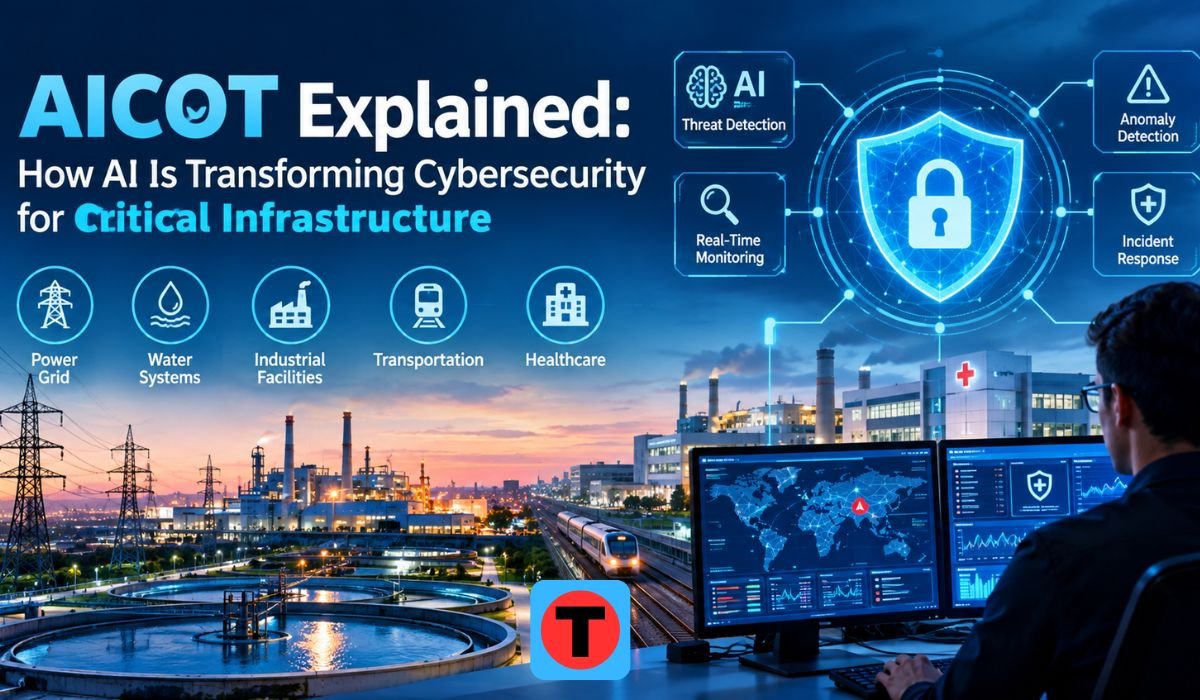
Critical Infrastructure is becoming more connected every year. Energy networks, water systems, transportation, manufacturing facilities, and other essential services increasingly depend on digital technology and Operational Technology (OT). This connectivity brings efficiency and better control, but it also creates new Cybersecurity challenges. AICOT is being developed in response to this changing environment. Its full description is AI-Driven Cyber Defense Platform for Operational Technology Environments in Critical Infrastructure. The project aims to combine Artificial Intelligence, Machine Learning, Anomaly Detection, OT Protocol Analysis, Threat Intelligence, and Real-Time Monitoring to improve Cyber Defense in industrial environments. AICOT builds on Logstail’s existing SIEM and Data Analytics capabilities and is intended to be validated in realistic OT environments.
Quick Facts About AICOT
| AICOT Information | Details |
|---|---|
| Project Name | AICOT |
| Full Description | AI-Driven Cyber Defense Platform for Operational Technology Environments in Critical Infrastructure |
| Main Focus | OT Cybersecurity |
| Core Technologies | AI, Machine Learning, Anomaly Detection, Protocol Analysis |
| Primary Environment | Operational Technology |
| Target Sectors | Energy, Transport, Water, Manufacturing, and Critical Infrastructure |
| Industrial Protocols | Modbus, DNP3, PROFINET, and IEC 61850 |
| Technology Foundation | Logstail SIEM and Data Analytics |
| Monitoring Goal | Real-Time OT Monitoring |
| Detection Goal | Context-Aware Threat Detection |
| CTI Focus | Secure and Privacy-Preserving Threat Intelligence Sharing |
| AI Direction | Proactive Detection of Stealthy and Previously Unseen Threats |
| Development Model | Modular and Scalable OT Cybersecurity Platform |
| Validation | Realistic OT Pilot Environments |
| Target Readiness | TRL 7–8 |
| European Objective | Digital Sovereignty and Cybersecurity Resilience |
| Project Status | Research, Development, and Validation |
These details describe AICOT’s published project objectives and development direction. They should not be interpreted as proof that every planned capability is already commercially deployed or fully demonstrated.
What Is AICOT?
AICOT is a European Cybersecurity project focused on protecting Operational Technology used in Critical Infrastructure. In simple terms, it is being designed to help security teams understand what is happening inside industrial environments and identify activity that may represent a Cybersecurity threat. Traditional security systems can be very effective at collecting logs and detecting known technical indicators, but industrial environments require additional context. AICOT therefore focuses on understanding OT-specific communications, behavior, telemetry, and operational relationships. The project aims to create a modular and scalable platform that combines monitoring, Threat Detection, response capabilities, Machine Learning, OT Protocol Analysis, and Threat Intelligence. The official project description says the platform will be validated in a pilot environment designed to replicate real-world OT systems.
Why Critical Infrastructure Needs Advanced Cybersecurity
Critical Infrastructure faces a different security challenge because a Cybersecurity incident can affect more than computers and data. Energy distribution, water treatment, manufacturing, and transportation depend on systems that interact with physical equipment. At the same time, many OT environments were designed years ago, before today’s level of Internet connectivity and remote access existed. AICOT identifies Energy, Transport, Water, and Manufacturing among the environments facing these challenges. It also highlights older technologies and industrial protocols such as Modbus, DNP3, PROFINET, and IEC 61850. Modern OT environments may also connect with Enterprise IT, Cloud Services, VPNs, vendor systems, and remote-access infrastructure. This makes visibility across the entire IT/OT environment increasingly important.
Understanding Operational Technology
Operational Technology refers to technology used to monitor and control physical processes. It includes equipment such as Programmable Logic Controllers, Supervisory Control and Data Acquisition systems, Human-Machine Interfaces, industrial controllers, sensors, and Engineering Workstations. A PLC, for example, can control machinery or a particular stage of an industrial process, while a SCADA environment can provide operators with visibility and control. This physical connection is what makes OT Cybersecurity different from many conventional IT security situations. Changing a setting on an ordinary office computer may affect information, while changing a controller or industrial process can affect production or physical operations. For that reason, AICOT’s focus is not simply on detecting suspicious network traffic. It is about understanding whether activity makes sense within the industrial environment.
OT Cybersecurity vs. Traditional IT Security
IT Security and OT Cybersecurity share many principles, but their priorities can differ. In an office environment, isolating a compromised endpoint or disabling an account may be a straightforward security action. In an industrial environment, suddenly disconnecting a system can potentially interrupt production or affect a safety-related process. OT environments can also contain legacy equipment that cannot easily receive modern security controls or software updates. AICOT’s approach recognizes the importance of operational context when analyzing security events. Current AICOT material emphasizes that AI detection should lead to contextual enrichment, analyst review, OT engineering validation, and controlled response rather than directly triggering an uncontrolled production change. This human-centered approach is consistent with broader guidance for safely integrating AI into OT environments.
How AICOT Uses Artificial Intelligence and Machine Learning
Artificial Intelligence and Machine Learning are central to the AICOT concept. The project aims to use advanced Machine Learning to analyze industrial telemetry and identify behavioral patterns that could indicate suspicious activity. It also describes research into Generative AI and Adversarial AI for proactive detection of stealthy and previously unseen threats. However, this should not be understood as a promise that AICOT can automatically identify every Zero-Day Attack. A more practical interpretation is that AI can help identify behavior that does not fit an established pattern and give security teams additional evidence for investigation. This is particularly useful when an attacker uses legitimate tools or techniques that may not match a traditional signature. AICOT’s goal is therefore to move toward more context-aware detection rather than relying only on known indicators.
AICOT and Anomaly Detection
Anomaly Detection is especially useful in OT because many industrial systems have relatively predictable communication patterns. A controller may normally communicate with a known set of devices, at expected times, using familiar protocols. A sudden change could deserve investigation. Yet an unusual event is not automatically malicious. Maintenance, equipment replacement, commissioning, production changes, or emergency procedures can all create behavior that differs from a normal baseline. AICOT’s approach therefore combines Anomaly Detection with asset information, behavioral analysis, OT Protocol Analysis, Threat Intelligence, and other security evidence. Current project material emphasizes that AI models need reliable telemetry and asset context to determine whether an event is genuinely unusual for a specific environment. The goal is not simply to identify something statistically different, but to understand whether the deviation makes sense operationally.
Industrial Protocol Analysis in AICOT
Industrial Protocol Analysis is another important part of AICOT. Industrial environments communicate through specialized protocols that may not be adequately understood by security systems designed primarily for conventional IT networks. AICOT specifically references Modbus, DNP3, PROFINET, and IEC 61850. Understanding these protocols can help security teams interpret industrial communications more accurately. Instead of seeing only that one device communicated with another, a security platform can work toward understanding the type and context of the communication. That knowledge can become especially useful when investigating unusual commands, unexpected connections, or changes involving important industrial assets. Protocol awareness also supports more meaningful Behavioral Analysis because the security system has more information about what normal communication looks like inside a particular OT environment.
Real-Time Monitoring and Threat Detection
AICOT is designed around Real-Time Monitoring, Threat Detection, and Response. Modern industrial environments generate security information from many different locations, including PLCs, RTUs, HMIs, SCADA servers, Engineering Workstations, firewalls, VPNs, identity systems, endpoints, and supporting infrastructure. AICOT-related research from Logstail emphasizes the value of connecting these signals rather than treating every alert as an isolated event. Imagine a remote user logging in, accessing an Engineering Workstation, communicating with an OT network, and then making an unusual change to a PLC. Each individual event could have a legitimate explanation, but the complete sequence may deserve urgent investigation. Contextual correlation can turn scattered technical events into a clearer security incident.
AICOT and Cyber Threat Intelligence
Cyber Threat Intelligence, commonly called CTI, can help organizations understand emerging threats, suspicious infrastructure, attack techniques, and unusual activity. In OT environments, however, sharing intelligence can be difficult because the information itself may be sensitive. Industrial data can reveal details about assets, network relationships, vulnerabilities, engineering systems, remote-access paths, and operational behavior. AICOT therefore includes secure and privacy-preserving CTI exchange as one of its objectives. The project describes a Blockchain-backed approach intended to support privacy, trust, auditability, and interoperability. The idea is that organizations should be able to learn from one another without unnecessarily exposing sensitive operational information.
The Role of Logstail in AICOT
Logstail plays a central role in the AICOT project. The project is led by Logstail and builds on its existing SIEM and Data Analytics capabilities. According to the AICOT Project, Logstail is responsible for areas including project coordination, platform development, AI research, secure CTI exchange, pilot deployment, and validation. AICOT is intended to extend the existing security-operations foundation with deeper OT capabilities, including Machine Learning, Anomaly Detection, OT Protocol Analysis, Behavioral Monitoring, Threat Intelligence, and AI-assisted Threat Detection. Logstail’s recent material also connects AICOT with broader security operations, asset visibility, incident investigation, response workflows, and OT monitoring.
AICOT and European Digital Sovereignty
AICOT also has a strategic European dimension. The project describes a goal of strengthening EU Digital Sovereignty through European-native, interoperable, reusable Cybersecurity technology. This matters because Critical Infrastructure operators may depend on technology supplied from many countries and vendors. AICOT’s stated objectives include supporting European technology development and strengthening the Cybersecurity supply chain. The project is associated with the European Union’s Digital Europe Programme under Grant Agreement No. 101249826. Its broader vision connects technical OT protection with Europe’s ability to develop and maintain trusted Cybersecurity capabilities for strategically important infrastructure.
AICOT Pilot Testing and Technology Readiness
AICOT is intended to be tested in realistic OT pilot environments. This is important because industrial Cybersecurity cannot be evaluated properly using only ordinary laboratory conditions. Real OT systems can contain legacy equipment, specialized protocols, strict uptime requirements, complicated dependencies, and safety considerations. The project identifies a target Technology Readiness Level of 7–8, reflecting an emphasis on demonstrating the technology in realistic or operationally relevant settings. It is important to describe this as a project target rather than claiming that AICOT has already reached every stage of that readiness level. Practical validation will help determine whether the platform can operate effectively across diverse industrial environments and whether its AI-driven detection produces useful results without creating unnecessary operational risk.
Practical Applications and Challenges
AICOT’s potential value becomes easier to understand through practical situations. Consider an Engineering Workstation that suddenly communicates with an unusual PLC, or a remote-access session followed by an unexpected industrial command. Another example could involve a legitimate maintenance operation that produces unusual traffic. An effective OT security platform needs enough context to distinguish these situations. That creates several challenges, including limited high-quality OT training data, changing industrial behavior, legacy equipment, false positives, false negatives, explainability, and integration complexity. Current AICOT material specifically notes the difficulty of building behavioral models when labeled OT attack datasets are limited. These limitations mean that AI should support experienced security analysts and OT engineers rather than operate as an uncontrolled replacement for them.
The Future of AI-Powered OT Cybersecurity
The future of Critical Infrastructure Cybersecurity is likely to involve closer cooperation between AI, Security Operations, industrial engineering, and operational teams. AICOT represents one approach to this direction by combining AI-driven monitoring with OT-specific Protocol Analysis, Anomaly Detection, Threat Intelligence, and response support. Other important capabilities remain essential, including secure remote access, network segmentation, asset visibility, vulnerability management, incident response, recovery planning, and trained personnel. Current guidance for AI in OT also emphasizes monitoring AI components, maintaining known-good states, using appropriate safety thresholds, and keeping humans involved in important decisions. AI can improve analysis and visibility, but it should operate within carefully designed safety and cybersecurity processes.
Final Thoughts
AICOT represents a developing approach to one of the most difficult problems in modern Cybersecurity: protecting digital systems that are directly connected to physical infrastructure. Its importance comes not simply from the use of Artificial Intelligence, but from the attempt to combine AI with an understanding of industrial behavior, OT protocols, asset context, Threat Intelligence, and real-time security operations.
The project aims to move beyond isolated alerts toward a more complete picture of what is happening inside an industrial environment. A VPN login, PLC command, Engineering Workstation event, firewall connection, or unusual protocol message may not mean much by itself. When these signals are connected with asset importance, vulnerabilities, identities, operational context, and related events, they can provide a much clearer picture of potential risk.
AICOT should therefore be viewed as an evolving research and development effort rather than as a claim that AI can solve OT security on its own. Its planned combination of Machine Learning, Anomaly Detection, Industrial Protocol Analysis, Threat Intelligence, Real-Time Monitoring, and context-aware response could help address some of the visibility challenges created by increasingly connected Critical Infrastructure. The continuing challenge will be making those capabilities accurate, explainable, safe, scalable, and genuinely useful to the people responsible for industrial operations.
FAQs About AICOT
What Is AICOT?
AICOT is an EU-focused Cybersecurity project developing an AI-driven platform for Operational Technology environments in Critical Infrastructure. It aims to combine Machine Learning, Anomaly Detection, OT Protocol Analysis, Threat Intelligence, and Real-Time Monitoring to support improved Cyber Defense.
What Does AICOT Stand For?
AICOT refers to the AI-Driven Cyber Defense Platform for Operational Technology Environments in Critical Infrastructure. The project focuses on applying AI and related Cybersecurity technologies specifically to industrial and Critical Infrastructure environments.
How Does AICOT Use AI?
AICOT aims to use Artificial Intelligence and Machine Learning to analyze OT telemetry, identify unusual behavior, support Threat Detection, and provide additional context for security investigations. The project also describes research involving Generative and Adversarial AI for proactive detection of stealthy and previously unseen threats.
What Is Operational Technology?
Operational Technology is technology used to monitor or control physical processes. Examples include PLCs, SCADA systems, HMIs, industrial controllers, sensors, and Engineering Workstations. OT is important to Cybersecurity because digital activity can directly affect physical operations.
Which Industrial Protocols Are Associated With AICOT?
The AICOT Project specifically identifies Modbus, DNP3, PROFINET, and IEC 61850. Understanding these protocols can help security systems interpret industrial communications and identify behavior that may be inconsistent with expected OT activity.
Is AICOT Already a Finished Commercial Product?
AICOT is described as a research, development, and validation project. Its published objectives include developing and validating a modular OT Cybersecurity platform through realistic pilot environments. Therefore, planned capabilities should not automatically be treated as fully demonstrated commercial features.
What Is Logstail’s Role in AICOT?
Logstail leads the project and provides the foundation of existing SIEM and Data Analytics capabilities. The project aims to extend that foundation with OT-specific Machine Learning, Anomaly Detection, Protocol Analysis, Threat Intelligence, monitoring, and response capabilities.
Can AICOT Replace Human Cybersecurity Professionals?
AICOT is intended to support Cybersecurity and OT teams rather than eliminate the need for human expertise. Industrial environments can involve safety and production consequences, so suspicious activity may require analyst investigation, OT engineering validation, and controlled response. Current guidance for AI-enabled OT also emphasizes human oversight and failsafe practices.
Learn more and explore exciting content on: Simpciry Explained: A Simple Guide to Mindful and Intentional Living






Leave a Reply